
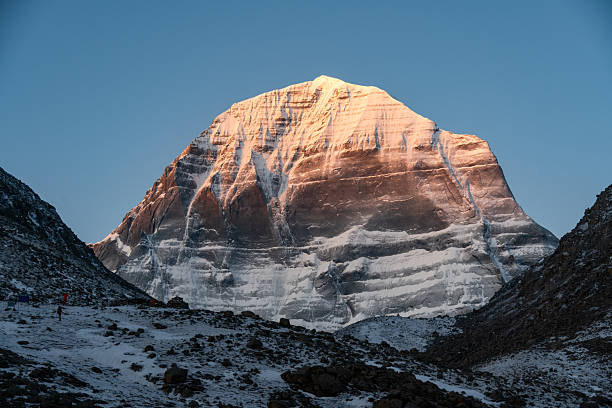
Standing proudly in Burang County of the Ngari Prefecture, Mount Kailash is the primary peak of the Gangdise Mountain Range. At an elevation of 6,638 meters, it is not the highest peak in Tibet, but it is undeniably the most prominent and deeply revered mountain across Asia.
The peak’s geography is instantly recognizable. Covered in perpetual snow, its summit forms a near-perfect four-sided pyramid pointing precisely toward the four cardinal directions. On its southern face, a massive vertical crevice runs down from the summit, intersecting horizontal rock strata to form a natural “Swastika (卐)”—a sacred Buddhist symbol—casting an aura of solemn divinity.
Furthermore, the surrounding region gives birth to four major rivers of Asia, including the Yarlung Tsangpo (Brahmaputra), the Sutlej, the Karnali, and the Indus, which nurtured ancient civilizations across the subcontinent.
Key Takeaways
Geographical & Physical Features: Located in Burang County, Ngari Prefecture, Mount Kailash stands at 6,638 meters (21,778 ft). It is famous for its symmetric four-sided pyramid peak and the natural “Swastika (卐)” symbol formed by vertical glacial crevices and horizontal rock strata.
Million-Year Geological Evolution: Originating from ocean floor deposits in the ancient Tethys Ocean, the mountain was uplifted by the tectonic collision between the Indian and Eurasian plates and carved by ice and weathering into its conglomerate pyramid structure.
Universal Holy Site for Four Religions: Revered by Tibetan Buddhism, Bon, Hinduism, and Jainism as the physical manifestation of “Mount Sumeru,” the cosmic center of the universe.
Spiritual Significance & Kora Culture: Pilgrims believe that walking the 52 km circuit (Kora) around the peak cleanses a lifetime of sins. Out of deep religious reverence, Mount Kailash remains strictly forbidden from being climbed.
From Ancient Ocean to Sacred Peak: The Geological Origin
Mount Kailash was not created overnight. Its formation is an epic tale of continental collision and glacial sculpting across millions of years:
Sedimentation in the Tethys Ocean (200 to 60 Million Years Ago)
Hundreds of millions of years ago, the area of modern Tibet lay submerged under the ancient Tethys Ocean. Rivers washed sand, pebbles, and gravel into the sea floor, where immense pressure compacted them over time into the dense conglomerate rock layers known today as the “Kailash Formation.”
Tectonic Collision and Continental Uplift (~55 Million Years Ago)
As the Indian Tectonic Plate drifted northward and violently collided with the Eurasian Plate, the Tethys Ocean closed. The Tibetan Plateau began its dramatic tectonic uplift, pushing the hardened Kailash conglomerate formations thousands of meters into the sky.
Glacial Carving and Weathering (Past Few Million Years)
Exposed to high-altitude freezing and Fourth Period glacial erosion, ice flows acted as massive chisels along the mountain’s natural faults. Over time, glaciers shaved off the surrounding mountain mass, leaving behind the solitary four-faced pyramid standing today.
Why Mount Kailash is the Ultimate Sacred Peak in Buddhism
In the cosmic worldview of Tibetan Buddhism and ancient Asian traditions, Mount Kailash holds an unshakeable status as the center of the universe.
1. The Physical Manifestation of “Mount Sumeru”
According to Buddhist scriptures such as the Abhidharmakośa, the center of the cosmos is occupied by a central holy mountain called Mount Sumeru, surrounded by oceans and continents. Mount Kailash’s distinct four-sided geometry, its role as the source of four great rivers, and its position amidst surrounding ranges led ancient scholars and spiritual masters to recognize it as the physical embodiment of Mount Sumeru on Earth.
2. The Abode of Chakrasamvara
In Tibetan Vajrayana Buddhism, Mount Kailash is revered as the mandala palace of Chakrasamvara (Demchok) and his consort Vajravārāhi. Historical traditions recall the great 11th-century yogi Milarepa engaging in a contest of spiritual prowess against the Bon master Naro Bonchang at the mountain, establishing the Buddhist spiritual lineage over the peak.
3. Shared Reverence Across Four Major Religions
Beyond Buddhism, Mount Kailash is a sacred pillar for three other ancient spiritual traditions:
Hinduism: Revered as Kailāsa, the eternal abode of Lord Shiva and his consort Goddess Parvati.
Bon (Tibet’s Indigenous Religion): Considered the “Nine-Story Swastika Mountain,” where the religion’s founder, Tonpa Shenrab, descended to Earth.
Jainism: Known as Ashtapada, the site where the first Jain Tirthankara, Rishabhanatha, attained spiritual liberation.
Washing Away Sins: The Kora Tradition and Ultimate Respect
Because of its unparalleled spiritual standing, pilgrims from Tibet, mainland China, India, Nepal, and around the world travel vast distances to reach its base.
Devotees believe that completing one full 52-kilometer trekking circuit (Kora) around the mountain—crossing the high Dolma La Pass at 5,630 meters—erases the karma of a lifetime. Many pilgrims perform full-body prostrations for the entire distance, demonstrating profound faith.
To honor its sacred heritage and preserve its natural purity, Mount Kailash remains strictly off-limits to mountaineers. Unconquered by human footsteps, the peak stands in eternal solitude amidst the clouds of the Tibetan plateau.