The towering peaks of the Tibetan Plateau have inspired awe, reverence, and deep spiritual devotion for millennia. Far more than mere geological formations, these summits are considered living deities, abodes of gods, and pivotal centers of cosmic energy. For followers of Buddhism, Hinduism, Jainism, and the indigenous Bon religion, the sacred mountains in Tibetan areas represent the ultimate destinations for pilgrimage and inner transformation. Travelers from across the globe are drawn to these remote landscapes not just for their breathtaking beauty, but for the profound sense of peace they offer. Among all these revered peaks, Kailash stands as the most universally recognized, drawing thousands of pilgrims who undertake arduous treks to complete its holy circuit. Understanding the cultural and spiritual context of these mountains is essential before planning any visit, as they demand respect, preparation, and an open heart.
Key Highlights:
- Mount Kailash is sacred to four major religions.
- Amnye Machen remains a vital pilgrimage site in Amdo Tibet.
- Kawagarbo is strictly unclimbed due to deep religious beliefs.
- Nyenchen Tanglha dominates the landscape near Namtso Lake.
- High altitude acclimatization is essential for all visitors.
The Supreme Sacred Mountain: Mount Kailash
No discussion about the sacred mountains in Tibetan areas is complete without focusing on Mount Kailash. Rising to an elevation of 6,638 meters in the remote Ngari Prefecture of western Tibet, Kailash is arguably the most venerated peak on the planet. What makes this mountain truly unique is its cross-religious significance. It is revered simultaneously by Buddhists, Hindus, Jains, and followers of the ancient Bon religion. Each tradition weaves its own rich mythology around the peak, yet all agree on its status as the center of the universe.
For Hindus, Kailash is the earthly manifestation of Mount Meru, the cosmic axis, and the eternal abode of Lord Shiva and his consort Parvati. Buddhists view it as the dwelling place of Demchok (Chakrasamvara), representing supreme bliss. Jains revere it as Ashtapada, the site where their first Tirthankara, Rishabhadeva, attained liberation. Meanwhile, the Bon religion considers it the seat of the sky goddess Sipaimen.
Unlike many other prominent peaks in the Himalayas, Kailash has never been climbed. Its distinct, symmetrical pyramid shape, capped with perpetual snow and flanked by sheer rock faces, makes it visually striking, but it is the deep religious sanctity that keeps mountaineers away. Out of respect for the beliefs of millions, climbing attempts are strictly prohibited. Instead, the primary way to engage with Kailash is through the Kora—a 52-kilometer circumambulation trek around the base of the mountain. Pilgrims believe that completing one Kora erases the sins of a lifetime, while completing 108 Koras guarantees enlightenment. The trek usually takes three days for regular travelers, though devout pilgrims may perform full-body prostrations along the entire route, extending the journey to several weeks. The highest point of the Kora is the Drolma La pass, sitting at a breathless 5,630 meters, offering a challenging but deeply rewarding experience.
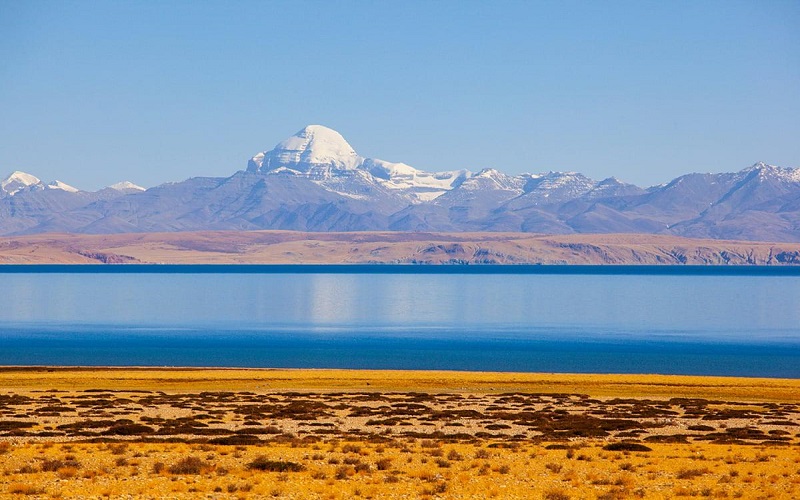
Mount Kailash
Amnye Machen: The Warrior Deity of Amdo
Located in the Golog Tibetan Autonomous Prefecture of Qinghai Province, Amnye Machen is another paramount figure among the sacred mountains in Tibetan areas. Reaching an elevation of 6,282 meters, it is the highest peak in the eastern Kunlun mountain range. In traditional Tibetan culture, particularly within the Amdo region, Amnye Machen is personified as a powerful warrior deity, a protector spirit who governs the surrounding lands and waters.
The mountain holds immense importance for local nomadic communities, whose lives and livelihoods are intimately tied to the pastures and rivers flowing from its glaciers. The Yellow River, one of Asia’s most significant waterways, bends dramatically around the Amnye Machen massif, creating stunning landscapes of alpine meadows and deep gorges. Historically, the pilgrimage around Amnye Machen was considered just as meritorious as the Kora around Kailash for those living in the eastern Tibetan regions.
Today, the trekking route around Amnye Machen attracts adventurers looking for a less crowded alternative to western Tibet. The circuit generally takes about seven to ten days to complete on foot or horseback. Because the region remains relatively untouched by mass tourism, visitors can experience authentic Tibetan nomadic culture, often being invited into yak-hair tents for butter tea and tsampa. The raw, rugged beauty of the terrain, combined with the palpable spiritual atmosphere, makes Amnye Machen a profoundly moving destination.
Kawagarbo: The Unconquered Peak of Yunnan
While technically situated in Yunnan Province near the border of the Tibet Autonomous Region, Kawagarbo is the highest and most sacred of the Meili Snow Mountains. Standing at 6,740 meters, it is a central pillar of faith for Tibetan Buddhists in the Kham and Yunnan regions. Kawagarbo is believed to be the incarnation of a fierce protective deity, and its name translates roughly to “white snow mountain.” It is one of the most important sacred mountains in Tibetan areas outside of the central plateau.
Kawagarbo shares a similar fate to Kailash regarding mountaineering; it remains unclimbed. Several expeditions attempted to summit the peak in the late 20th century, but all failed, some tragically. Following these events, local authorities officially banned climbing out of respect for the religious sentiments of the Tibetan people. The belief is that setting foot on the summit would anger the deity, bringing misfortune to the region.
Instead of climbing, pilgrims and hikers undertake the inner and outer Kora routes. The inner Kora is particularly spectacular, taking trekkers through dense rhododendron forests, over high passes adorned with prayer flags, and past glacial lakes that mirror the jagged peaks above. The best vantage point to witness the glory of Kawagarbo is from the Feilai Temple viewing platform, where early risers gather hoping to see the rare phenomenon of the sun illuminating the summit in brilliant gold—a sight locals consider highly auspicious.
Nyenchen Tanglha: Guardian of the Northern Plains
Stretching across the northern part of the Tibet Autonomous Region, the Nyenchen Tanglha range serves as a massive geographical divide. Its main peak, reaching 7,162 meters, is revered as a formidable mountain god. According to Tibetan mythology, Nyenchen Tanglha is a wealthy, sometimes wrathful deity who controls the weather and protects the vast Changtang plateau.
The mountain is intrinsically linked to Namtso, one of the highest and largest saltwater lakes in the world. In local legends, Nyenchen Tanglha and Namtso are depicted as a divine couple, their proximity symbolizing the harmonious balance of male and female energies in nature. Driving along the shores of Namtso with the snow-capped massif of Nyenchen Tanglha dominating the southern horizon is one of the most iconic visual experiences in Tibet.
While it does not draw the same volume of international pilgrims as Kailash, Nyenchen Tanglha remains deeply significant to local herders. Small shrines and cairns made of mani stones dot the passes and valleys surrounding the range. Trekkers exploring the northern routes from Lhasa toward Nagqu frequently encounter the imposing presence of this mountain, which serves as a constant reminder of the spiritual geography that defines the Tibetan plateau.
Practical Guidance for Visiting Sacred Mountains in Tibetan Areas
Traveling to these sacred mountains in Tibetan areas requires careful logistical planning and physical preparation. The extreme altitudes, ranging from 4,000 to over 5,500 meters on the trekking passes, mean that altitude sickness is a genuine risk. Visitors must spend several days acclimatizing in cities like Lhasa or Shangri-La before attempting any high-altitude treks. Hydration, gradual ascent, and avoiding strenuous activity upon arrival are critical steps for a safe journey.
Furthermore, accessing many of these regions requires specific travel permits. Foreign travelers visiting the Tibet Autonomous Region, including the area around Kailash, must obtain a Tibet Travel Permit and travel with a registered guide. Planning these logistics independently can be overwhelming due to the complex regulations and remote infrastructure. This is where specialized agencies prove invaluable. For instance, Tibet Yulong Travel offers comprehensive services tailored to these exact journeys. They handle permit applications, arrange reliable transportation across rugged terrains, and provide experienced local guides who understand both the physical demands of the treks and the cultural nuances required when visiting holy sites. Utilizing an agency like Tibet Yulong Travel ensures that your pilgrimage or adventure is conducted safely, legally, and with deep respect for local traditions.
Cultural etiquette is equally important. When visiting any of these peaks, travelers should always walk clockwise during circumambulations, as dictated by Buddhist and Hindu traditions (Bon practitioners walk counter-clockwise). Never climb onto mani stone mounds, avoid pointing your feet toward sacred objects or altars, and always ask for permission before photographing local pilgrims. Dress modestly and maintain a quiet, respectful demeanor, especially near monasteries and shrines located along the trekking routes.
Finally, the environmental fragility of the Tibetan Plateau cannot be overstated. These pristine ecosystems are highly vulnerable to pollution. Practicing strict leave-no-trace principles—packing out all waste, avoiding single-use plastics, and staying on established trails—is essential to preserving the sanctity and natural beauty of these landscapes for future generations of pilgrims and travelers alike. The enduring power of these mountains lies not only in their physical grandeur but in the collective reverence they inspire, making every step taken around them a journey inward.