
Mount Kailash is one of the most mysterious mountains on Earth—not because it is the highest, but because of the extraordinary beliefs, legends, landscapes, and unanswered questions surrounding it. Revered by Buddhists, Hindus, Jains, and followers of the Bon tradition, this remote peak in western Tibet has never been officially climbed and remains at the center of ancient pilgrimage traditions. From its unusual pyramid-like appearance and sacred snow-covered summit to the four great rivers associated with the region, Mount Kailash seems to sit at the intersection of geography, mythology, and spirituality.
Key Points
- Mount Kailash is sacred to Tibetan Buddhism, Hinduism, Jainism, and Bon, with different traditions giving the mountain their own names and stories.
- Its solitary shape, four-sided appearance, permanent-looking snow cap, and inaccessible summit have inspired centuries of legends.
- The region is associated with the four great rivers of Asia, including the Indus, Sutlej, Brahmaputra, and Karnali.
- Pilgrims do not climb Mount Kailash. Instead, they complete the Mount Kailash Kora, a demanding circumambulation around the mountain.
- Stories about Mount Meru, Shambhala, the Axis Mundi, Shiva, Milarepa, and sacred symbols make Kailash much more than a geographical landmark.
- Many claims surrounding Kailash are spiritual traditions or modern theories rather than scientifically established facts, which is precisely what makes the mountain so fascinating.
Where Is Mount Kailash?
Mount Kailash stands in Ngari Prefecture in western Tibet, in one of the most remote landscapes on the Tibetan Plateau. At approximately 6,638 meters (21,778 feet), it is far lower than Mount Everest, yet its cultural importance arguably extends far beyond its physical height.
The mountain rises near two other remarkable landmarks: Lake Manasarovar and Lake Rakshastal. Together, these landscapes form one of the most sacred pilgrimage regions in Asia. The surrounding plateau is characterized by enormous open spaces, high-altitude deserts, glaciers, snow-covered mountains, and exceptionally clear skies.
Its remoteness is part of its mystery. There are no major cities surrounding Kailash, and the journey itself requires travelers to cross vast stretches of western Tibet. For many visitors, the mountain does not simply appear as another attraction on a sightseeing itinerary. It emerges gradually from an immense landscape, often seeming almost unreal because of its isolated position.
Unlike many famous mountains, Kailash is not primarily famous because mountaineers want to conquer it. Its importance comes from something very different: people come here to worship it rather than climb it.
That distinction is fundamental to understanding why Mount Kailash remains mysterious.
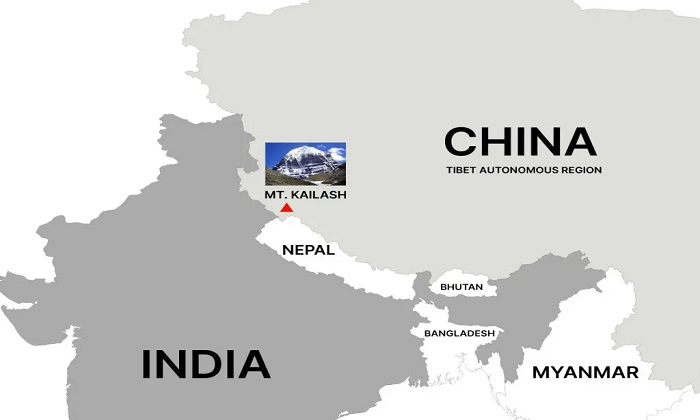
Mount Kailash Location Map
Why Does Mount Kailash Have So Many Names?
One of the first clues to Kailash’s spiritual importance is its extraordinary collection of names.
In Sanskrit, the mountain is known as Kailāsa, a name sometimes associated with the meaning “crystal.” In Tibetan, it is commonly called Gang Rinpoche, meaning “Precious Snow Jewel” or “Precious Jewel of Snows.” The name reflects the mountain’s brilliant white appearance and its revered status in Tibetan culture.
Different religious traditions have developed their own descriptions of the mountain. Tibetan Buddhist traditions regard it as a sacred cosmic mountain, while Hindu traditions identify it as the dwelling place of Lord Shiva. Bon traditions preserve their own ancient stories connected with the peak and the surrounding sacred landscape.
Local traditions also associate the mountain with the name Tisé.
These names are more than translations. Each one reflects a different way of understanding the same physical landscape. To a geographer, Kailash is a mountain in the Himalaya-Tibetan Plateau region. To a Buddhist pilgrim, it can represent the cosmic center of existence. To a Hindu devotee, it is associated with Shiva’s divine abode.
The mountain therefore becomes a kind of meeting point between different religious worldviews.
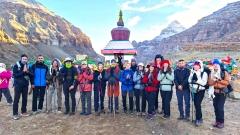
Mount Kailash As Mount Meru: The Center Of The Buddhist Universe
Perhaps the most important Buddhist mystery surrounding Kailash is its identification with Mount Meru, the mythical cosmic mountain described in Buddhist cosmology.
Mount Meru is traditionally understood as the central axis of the universe. It is not simply another mountain but a cosmic structure around which worlds and realms are organized.
Within Tibetan Buddhist traditions, Mount Kailash is closely associated with this sacred concept. Its unusual symmetry and isolated position make the comparison especially compelling to pilgrims.
Standing before Kailash, it is easy to understand why an ancient civilization might interpret such a mountain as something more than a geological formation. It rises dramatically from an otherwise immense and open landscape, while its steep faces and snow-covered summit create an almost architectural appearance.
This is one reason Kailash is sometimes described as the “navel of the world” or the spiritual center of the universe.
Whether one interprets Mount Meru literally, symbolically, or spiritually depends on one’s religious tradition. The enduring importance of the idea, however, is undeniable: Kailash represents a place where the physical landscape becomes a metaphor for the structure of existence itself.
Why Is Mount Kailash Sacred To Hindus?
For Hindus, Mount Kailash has an entirely different but equally profound identity.
It is traditionally regarded as the abode of Lord Shiva, one of the most important deities in Hinduism. According to Hindu tradition, Shiva resides on the mountain in deep meditation together with his consort Parvati.
Their sons, Ganesha and Kartikeya, and Shiva’s sacred vehicle, Nandi, are also associated with the divine household surrounding Kailash.
This belief transforms the mountain from a distant Himalayan peak into a sacred residence.
For Hindu pilgrims, traveling toward Kailash is therefore not simply an adventure. It is an act of devotion. The difficult journey across western Tibet becomes part of the spiritual experience, and seeing the mountain can carry profound religious meaning.
The mountain’s association with Shiva also helps explain why climbing Kailash is considered inappropriate within traditional pilgrimage culture. The objective is not to conquer the mountain but to approach it with humility.
This is one of the most striking differences between Kailash and many other famous mountains.
Everest represents achievement through ascent. Kailash represents devotion through circumambulation.
Is Mount Kailash A Link Between Earth And Heaven?
Another enduring belief is that Mount Kailash represents a connection between the earthly and divine realms.
Its four principal faces are traditionally associated with the four cardinal directions. In several religious traditions, the mountain is imagined as an axis connecting different levels of existence.
This concept is sometimes called the Axis Mundi, or “axis of the world.”
The idea appears in many cultures around the world. Sacred mountains, trees, temples, and other structures have often been imagined as points where heaven, earth, and the underworld meet.
Kailash is particularly powerful in this context because of its physical appearance. The mountain rises abruptly above the surrounding plateau, giving it a visual quality that naturally encourages symbolic interpretation.
Ancient stories also connect the region with spiritual journeys toward liberation. Hindu traditions associate the area with the Pandavas and Draupadi, who are said to have traveled toward the Himalayas in search of spiritual release.
The historical details of these stories belong to religious tradition rather than modern geography, but they remain an important part of Kailash’s cultural identity.
Does Mount Kailash Really Look Like A Pyramid?
One of the most frequently repeated modern mysteries about Kailash concerns its shape.
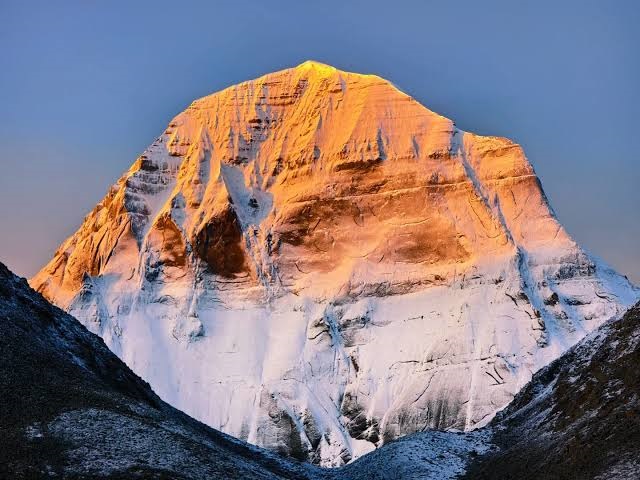
From certain viewpoints, the mountain appears remarkably symmetrical. Its four-sided profile, steep faces, and relatively isolated position can make it resemble a giant pyramid rising from the Tibetan Plateau.
This appearance has led to theories claiming that Kailash might be an artificial or “vacuum pyramid,” sometimes accompanied by claims about surrounding pyramid-like structures.
Such ideas have become popular in books, websites, documentaries, and online discussions about the mountain.
However, these claims should be treated carefully. There is no established scientific evidence that Mount Kailash is a man-made pyramid. The mountain’s unusual appearance can be understood within the context of natural geological structures, erosion, glaciation, rock formations, and perspective.
The pyramid theory nevertheless contributes to the mountain’s modern mythology.
And perhaps that is part of Kailash’s appeal. Visitors can look at the mountain and immediately understand why people have wondered whether its shape contains a deeper meaning.
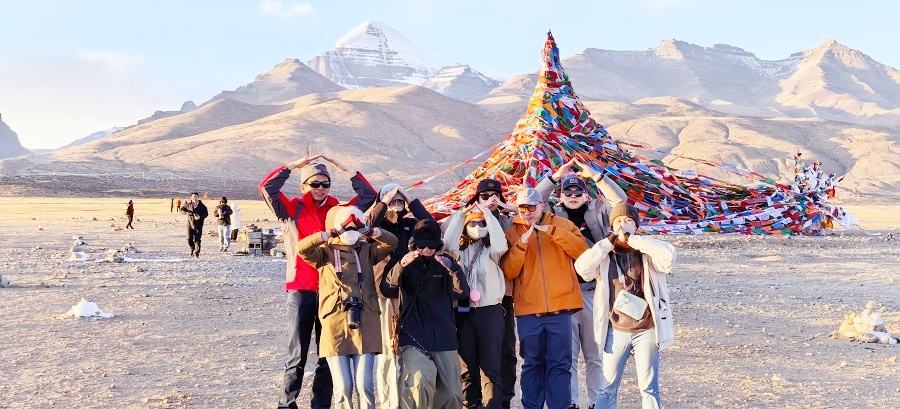
Mount Kailash Tourists
Why Does The Snow On Mount Kailash Seem Never To Melt?
Another famous Kailash mystery concerns its snow-covered summit.
The mountain’s upper slopes frequently remain covered in snow, creating a bright white crown above its darker rock faces. Because of the mountain’s extreme elevation and local climate, snow and ice can persist at high elevations even when lower areas appear dry and relatively warm.
To pilgrims, however, the enduring white summit has a much deeper meaning.
The snow is often interpreted as a symbol of purity, permanence, and spiritual power. The contrast between the white summit and the barren brown-gold landscape surrounding it can make Kailash appear almost supernatural.
The mountain’s visual character changes throughout the day. Morning light can illuminate one face while leaving another in shadow. Clouds may briefly hide the summit before revealing it again. Sunset can turn the snow from white to gold, pink, and deep orange.
These constantly changing appearances help sustain the sense that Kailash is never quite the same mountain twice.
Why Has Nobody Climbed Mount Kailash?
Perhaps the greatest mystery is also the simplest question:
Why has Mount Kailash never been climbed?
At 6,638 meters, Kailash is not the highest mountain in the Himalayas. Many significantly higher peaks have been successfully climbed.
Yet Kailash remains unclimbed.
The primary reason is cultural and religious rather than simply technical. Climbing the sacred mountain is widely regarded as inappropriate or forbidden by the religious traditions that revere it.
The mountain is not considered an objective to conquer.
There are stories about the Buddhist master Milarepa, who is said in legend to have reached the summit during a spiritual contest. These stories belong to the religious and legendary tradition surrounding Kailash and are not evidence of a modern mountaineering ascent.
There have also been modern discussions about climbing the mountain, but no recognized successful summit expedition has established Kailash as a conventional climbing objective.
Its unclimbed status has therefore become part of its identity.
In a world where people have climbed Everest, skied across polar regions, descended deep caves, and reached increasingly remote locations, Kailash remains an unusual exception: a famous mountain that humanity has largely chosen not to conquer.
What Is The Mount Kailash Kora?
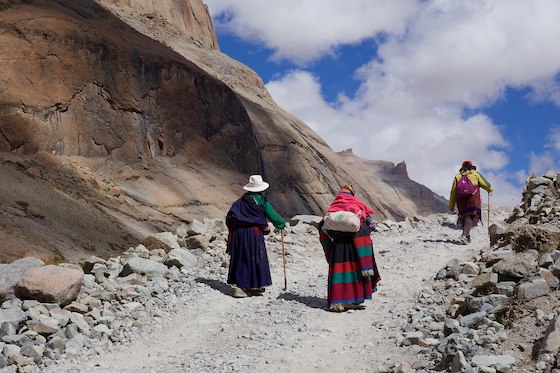
Instead of climbing the summit, pilgrims undertake the Mount Kailash Kora, a circumambulation of the mountain.
“Kora” is a Tibetan term referring to a sacred journey around a religious object, place, or mountain.
The traditional Kailash Kora covers roughly 52–53 kilometers and is normally completed over several days. The route begins near Darchen and passes through dramatic landscapes, including the area around Dirapuk Monastery and the high Drolma La Pass, which rises to approximately 5,630 meters.
The Kora is physically demanding even for experienced travelers.
At such altitude, every kilometer feels different from walking at sea level. Thin air, cold temperatures, strong ultraviolet radiation, rocky trails, and steep ascents combine to make the journey challenging.
Yet the physical hardship is part of the pilgrimage.
Tibetan pilgrims may walk while turning prayer wheels, reciting mantras, carrying prayer beads, or performing repeated full-body prostrations. For many, completing the Kora represents purification, devotion, and spiritual transformation.
The direction of the Kora also matters. In Tibetan Buddhist tradition, pilgrims generally travel clockwise around Kailash.
Why Do Pilgrims Prostrate Around Mount Kailash?
One of the most striking sights around Kailash is the sight of pilgrims performing prostrations.
A pilgrim may stand, place their hands together, kneel, lower their body to the ground, stand again, and repeat the process while gradually moving along the pilgrimage route.
This can transform a journey that would normally take several days into a much longer spiritual undertaking.
The physical act is demanding, but its meaning is more important than its difficulty. Prostration expresses humility and devotion, while the repetitive movement turns the journey into a form of meditation.
For international visitors, witnessing this tradition can be deeply moving. However, it is important to remember that pilgrims are not performers. Travelers should observe respectfully, avoid intrusive photography, and understand that the Kora is a living religious practice rather than a tourist attraction.
Does Mount Kailash Really Create A Swastika Or Om Symbol?
Some of the most visually fascinating Kailash stories involve sacred symbols that are said to appear on or around the mountain.
One is the swastika, an ancient symbol that has deep religious significance in Hinduism, Buddhism, Jainism, and other Asian traditions. In these contexts, the symbol predates and is entirely distinct from its later appropriation by Nazi Germany.
Another popular story concerns Om Parvat, where patterns in snow are said to resemble the sacred Sanskrit syllable “Om.”
These phenomena have contributed enormously to the mythology surrounding sacred Himalayan mountains.
However, photographs and visual patterns should be interpreted carefully. Snow, shadow, rock strata, lighting, perspective, and human pattern recognition can create striking shapes that different observers interpret in different ways.
For believers, the symbolism may be spiritually meaningful. For others, it may be a fascinating example of how humans find meaning in natural landscapes.
Either way, these visual traditions add another layer to Kailash’s mystery.
Why Is Mount Kailash Connected With Four Great Rivers?
Perhaps the most extraordinary geographical feature of the Kailash region is its relationship with several major river systems.
The area around Mount Kailash and the nearby lakes is associated with the origins of four major rivers:
- Indus River
- Sutlej River
- Brahmaputra River
- Karnali River
These rivers eventually flow in different directions across Asia, connecting the Tibetan Plateau with enormous regions of South and Central Asia.
The Brahmaputra, known as the Yarlung Tsangpo in Tibet, flows eastward across southern Tibet before turning dramatically through the Himalayas toward India and Bangladesh.
The Indus travels toward South Asia and Pakistan, while the Sutlej flows toward India. The Karnali eventually joins the Ganges river system in Nepal and India.
For ancient cultures, the existence of multiple great rivers in such a remote region must have seemed extraordinary.
The mountains and glaciers of western Tibet therefore became associated not only with sacred geography but also with the physical lifelines of entire civilizations.
Is Mount Kailash The Axis Mundi?
The idea of Mount Kailash as the Axis Mundi combines many of its most important mysteries.
An Axis Mundi is essentially a symbolic center of the world—a point connecting heaven, earth, and different realms of existence.
In Tibetan Buddhist thought, Kailash’s association with Mount Meru gives it cosmic importance. Hindu traditions connect it with Shiva’s divine residence. Jain traditions also preserve sacred associations with the mountain. Bon traditions have their own ancient narratives connected with the region.
This remarkable convergence means that one physical mountain has become central to several religious cosmologies.
The significance of Kailash therefore cannot be measured by elevation alone.
It is a mountain whose importance exists simultaneously in geography, religion, mythology, pilgrimage, and cultural memory.
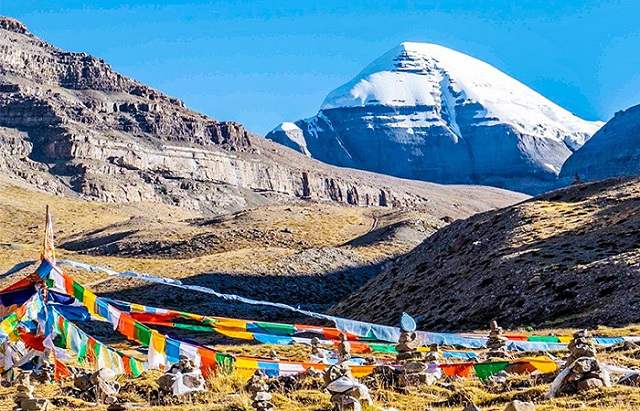
Mount Kailash
What Is The Connection Between Mount Kailash And Shambhala?
Another fascinating legend associated with the wider Himalayan region is Shambhala, the mythical kingdom described in Tibetan Buddhist traditions.
Shambhala is often portrayed as an enlightened realm, a place of spiritual wisdom and harmony rather than an ordinary geographical kingdom.
Over time, writers and travelers have associated Shambhala with the Himalayas and Tibetan Plateau, sometimes placing it near Mount Kailash.
These associations should be understood as part of religious mythology rather than as a confirmed geographic location.
Nevertheless, the connection is understandable.
Western Tibet is an enormous landscape of remote valleys, high plateaus, sacred lakes, ancient monasteries, and mountains that can remain isolated for weeks or months due to weather and geography. It is precisely the kind of environment in which stories of hidden kingdoms and sacred realms can flourish.
Kailash therefore sits within a larger cultural landscape where the boundaries between physical geography and spiritual imagination are unusually thin.
Why Is Mount Kailash So Isolated?
Kailash’s physical isolation is one of the simplest explanations for its mysterious reputation.
The mountain lies in far western Tibet, thousands of meters above sea level and far from the major urban centers of China, Nepal, or India.
Getting there requires a long overland journey or a carefully organized expedition. Roads have improved dramatically, but the region remains remote compared with Lhasa or Shigatse.
This isolation has preserved something that is increasingly rare in modern tourism: a genuine feeling of distance.
The landscape around Kailash is enormous. Roads can run for hours through empty valleys without passing through a large settlement. Herds of yaks or wild donkeys may appear against a mountain backdrop, while distant snow peaks rise above the plateau.
There are few visual distractions.
That emptiness changes the way travelers experience the mountain. Instead of seeing Kailash surrounded by hotels, restaurants, cable cars, or large commercial developments, visitors encounter it within an overwhelmingly natural landscape.
What Wildlife Can You See Around Mount Kailash?
Although the Kailash region is not known for dense wildlife populations, its high-altitude ecosystem supports several remarkable species.
Travelers may encounter Tibetan wild asses, Tibetan antelopes, yaks, swans, and black-necked cranes, particularly around wetlands and river valleys.
The animals often appear surprisingly distant from human activity.
This is another aspect of the region’s atmosphere. Wildlife is not guaranteed, and sightings can be brief. A herd may appear on the horizon and disappear moments later behind a ridge.
The surrounding rivers and lakes create important habitats in an otherwise harsh environment.
The contrast between seemingly barren mountains and hidden ecological richness is one of the lesser-known dimensions of a Mount Kailash journey.
Why Do People Say Mount Kailash Is The Center Of The World?
Calling Kailash the “center of the world” should be understood primarily as a religious and symbolic concept, rather than a scientific geographic measurement.
Various modern sources have attempted to calculate distances between Kailash and other famous monuments or geographic points, presenting numerical relationships as evidence that the mountain occupies a special geometric position.
These claims are intriguing but should not be confused with established scientific findings.
The deeper truth is perhaps more interesting.
Across different civilizations, people have repeatedly chosen certain mountains, temples, trees, or sacred landscapes as symbolic centers of the universe. Kailash is one of the most powerful examples because multiple religious traditions independently regard the region as sacred.
Its importance therefore does not depend on proving a mathematical alignment.
The symbolism itself is the mystery.
The Real Mystery Of Mount Kailash
After examining the legends, geography, religion, and modern theories surrounding Kailash, an important distinction emerges.
Some stories are religious beliefs. Some are ancient legends. Some are modern theories. Others are simply remarkable natural phenomena that remain visually impressive without requiring a supernatural explanation.
Trying to prove every Kailash legend scientifically can actually miss the point.
The mountain’s mystery comes from the way these different layers overlap.
A natural mountain becomes a sacred mountain. A remote landscape becomes a pilgrimage route. A snow-covered peak becomes a symbol of purity. A group of rivers becomes part of a sacred geography. A difficult trail becomes a spiritual journey.
This is why Mount Kailash continues to fascinate people who come from very different backgrounds.
You do not have to share the religious beliefs surrounding Kailash to appreciate its significance.
Mt Kailash
How To Experience The Mystery Of Mount Kailash
For international travelers, the most meaningful way to experience Kailash is not simply to arrive, take photographs, and leave.
The journey should be approached slowly.
Most visitors travel through western Tibet toward Darchen, the principal starting point for the Kora. A typical pilgrimage itinerary may combine Lhasa, Shigatse, Everest Base Camp, Saga, Lake Manasarovar, Mount Kailash, and the Kora itself.
Because of the altitude and remoteness, proper acclimatization is essential. Travelers should allow sufficient time at lower elevations before undertaking the Kora and should never underestimate the physical demands of the route.
Respect for local religious practices is equally important. Ask before photographing pilgrims, monasteries, or religious ceremonies. Follow the guidance of your Tibetan guide, avoid disturbing sacred objects, and remember that Mount Kailash is first and foremost a place of worship.
Traveling To Mount Kailash With Tibet Yulong
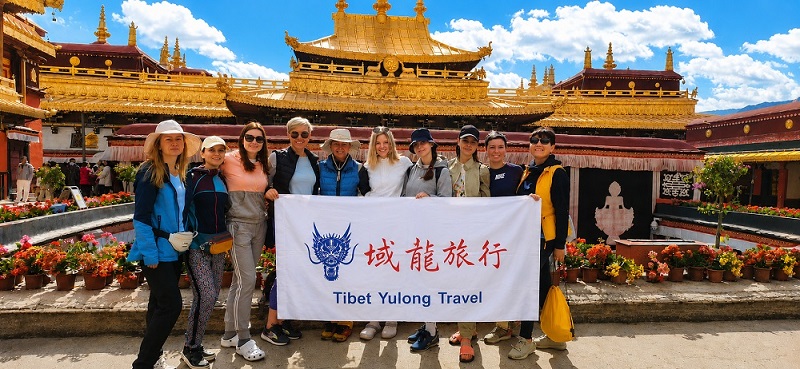
For international travelers planning a Mount Kailash pilgrimage, working with an experienced local Tibet travel agency can make the complicated logistics considerably easier. Tibet Yulong specializes in Tibet tours for overseas visitors and can help arrange transportation, accommodation, permits, guides, and high-altitude travel logistics for Mount Kailash and Lake Manasarovar journeys. A well-planned itinerary can combine the spiritual experience of the Kailash Kora with some of Tibet’s most remarkable destinations, including Lhasa, Shigatse, Everest Base Camp, and the Himalayan landscapes of western Tibet.
Why Is Mount Kailash So Mysterious?
Mount Kailash is mysterious because it refuses to fit neatly into a single category. It is a mountain, but also a pilgrimage destination. It is a geological formation, but also a cosmic symbol. It is remote wilderness, yet it has influenced the beliefs of millions of people. It is high enough to appear formidable, but not high enough to explain its extraordinary fame through altitude alone.
Its summit remains unclimbed. Its snow-covered faces dominate the surrounding plateau. Four major rivers are associated with the region. Pilgrims walk around it rather than attempting to stand on its summit. Ancient stories connect it with Shiva, Mount Meru, liberation, and sacred cosmology, while modern travelers continue to debate its unusual shape and visual phenomena.
Perhaps the greatest mystery is not whether Mount Kailash is a pyramid, an axis of the world, or a supernatural structure. Perhaps it is simply this: why has one mountain inspired so many different civilizations to see something sacred in it?
Standing beneath Kailash, surrounded by the enormous silence of western Tibet, that question feels less like something that needs an answer and more like part of the journey itself.