
✨ Highlights:
- 📜 Historic Origin: Samye Monastery Tibet first Buddhist temple was founded in 779 CE under King Trisong Detsen, establishing Tibet’s first complete Buddhist system with ordained monks and official Dharma inheritance.
- 🏛️ Unique Cosmic Architecture: Features a one-of-a-kind mandala layout simulating the Buddhist universe, with the central Utse Hall symbolizing Mount Meru and surrounding structures representing Buddhist cosmic geography.
- 🎨 Three-Style Integration Design: As a landmark of cultural fusion, Samye Monastery Tibet blends traditional Tibetan, Tang Han Chinese, and Indian architectural styles in one complete structure.
- 🏺 Precious Cultural Heritage: Boasts well-preserved ancient murals, Buddha statues, and scripture scrolls, recording the full evolution of early Tibetan Buddhism and plateau civilization.
- 🧭 Travel Guide Value: A core destination in Samye Monastery Shannan Tibet travel guide, ideal for travelers planning tovisit Samye Monastery from Lhasa for cultural and pilgrimage tours.
- 🙏 Irreplaceable Religious Status: Exploring Samye Monastery history reveals the origin of institutional Tibetan Buddhism, making it the cradle of all modern Tibetan Buddhist sects.
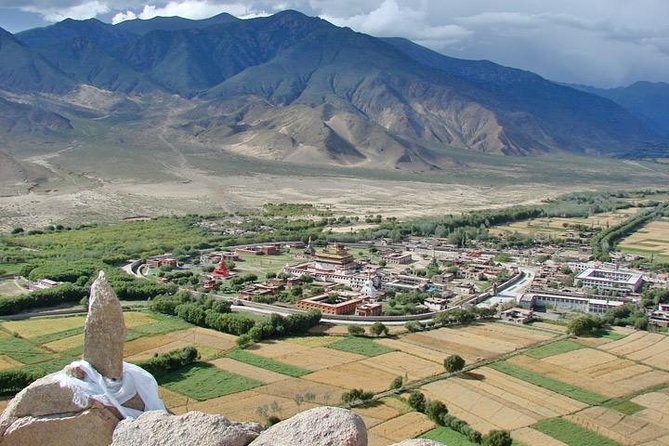
Nestled quietly at the foot of Hapori Mountain along the northern bank of the Yarlung Zangbo River in Shannan, Tibet Autonomous Region, Samye Monastery Tibet first Buddhist temple is universally recognized as the first formal, standardized, and institutionalized Buddhist temple in Tibetan history. With a history of over 1,200 years, this time-honored sacred site stands as the authentic cradle of Tibetan Buddhism, marking the official localization and institutional development of Buddhist culture on the Qinghai-Tibet Plateau.
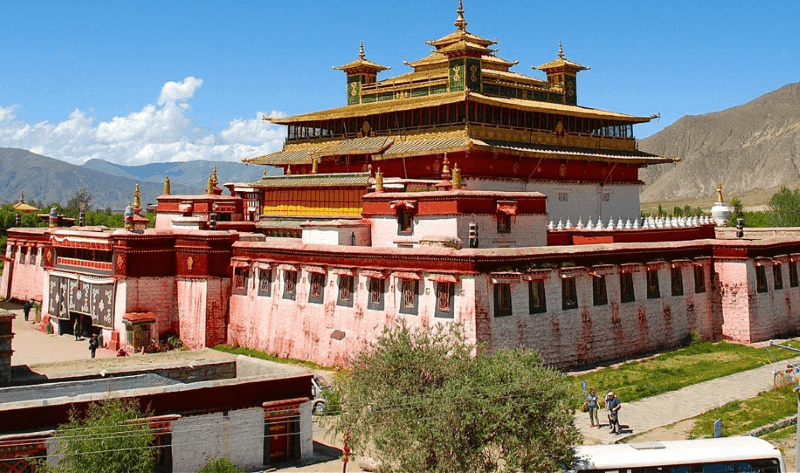
More than a religious landmark, Samye Monastery serves as a living museum that records the integration of Indian Buddhism, Han Buddhist culture, and indigenous Tibet Bon traditions. Its unique architectural design, profound historical background, and complete religious inheritance make it one of the most valuable cultural and spiritual heritage sites on the plateau. For global travelers, religious researchers, and cultural enthusiasts, exploring this ancient monastery is the best way to trace the origin and complete development of traditional Tibetan Buddhism.
The Grand Historical Origin of Samye Monastery
Religious Background Before the Founding of Samye Monastery
The birth of Samye Monastery, Tibet’s first Buddhist temple, is closely tied to the religious reform and cultural development of the Tubo Dynasty, and exploring Samye Monastery history allows people to fully understand the origin and evolution of Tibetan institutional Buddhism. Before the 8th century, the indigenous Bon religion dominated the spiritual life of Tibet people. Bon focused on nature worship, witchcraft rituals, and mountain god beliefs, forming a relatively closed and localized religious system. Although Buddhism had been introduced to Tibet in the early Tubo period, it failed to take root stably due to the lack of formal temples, ordained monks, and systematic doctrines, remaining in a sporadic and fragmented state for a long time.
Construction and Consecration of the Ancient Monastery
During the reign of King Trisong Detsen, the Tubo Dynasty reached its peak of prosperity and cultural openness. Determined to unify regional spiritual beliefs and introduce mature Buddhist civilization, the king actively promoted the development of Buddhism in Tibet. He specially invited two top Buddhist masters from India—Shantarakshita, a master of Mahayana Buddhist philosophy, and Guru Padmasambhava, the founder of Tibetan Vajrayana—to preside over the planning, construction, and consecration of the official Buddhist temple.
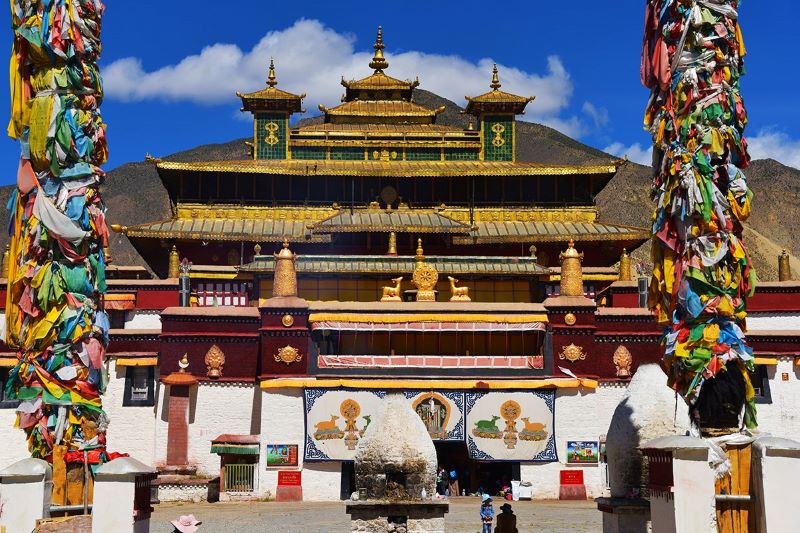
The construction project started in 763 CE and lasted for 16 years, finally completed and officially consecrated in 779 CE. The entire construction process was accompanied by the integration of Buddhism and local folk beliefs. Guru Padmasambhava used tantric wisdom to subdue local mountain deities and protective spirits that resisted Buddhist dissemination, resolving major obstacles for the spread of Buddhism on the plateau. After the temple’s completion, a landmark event took place: seven local Tibetan young men accepted formal tonsure, ordination, and Buddhist precepts, known as the “Seven Trial Monks” in Tibetan Buddhist history.
This crucial move established the first official monk community in Tibet, completing the complete religious system of Buddha (sacred statues), Dharma (sacred scriptures), and Sangha (monks). From this point on, Tibet bid farewell to the primitive scattered religious state, and Samye Monastery officially secured its status as Tibet’s first Buddhist temple, laying the fundamental foundation for the prosperity and inheritance of Tibetan Buddhism for thousands of years.
Unique Mandala Architectural Layout and Cosmic Philosophy
Buddhist Cosmic Layout Design
What makes Samye Monastery irreplaceable among all Tibetan Buddhist temples is its world-unique architectural layout that fully simulates the ancient Buddhist cosmic view. Covering a total area of 27,000 square meters, the entire temple complex is constructed in strict accordance with the Buddhist mandala ritual system, forming a three-dimensional physical model of the Buddhist universe, which is extremely rare in global ancient religious architecture.
Core Architectural Composition and Symbolic Meaning
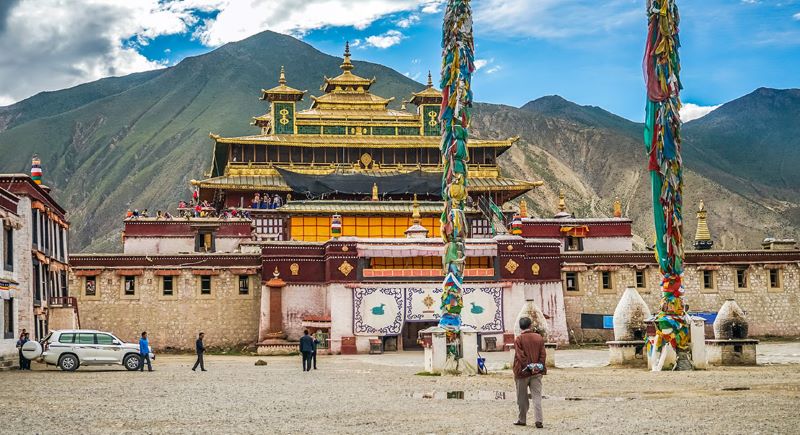
At the core of the monastery stands the grand Utse Hall, the main hall of Samye Monastery, which symbolizes Mount Meru—the sacred center of the Buddhist universe. Tall, grand, and solemn, the main hall is the spiritual and geometric core of the entire temple group. Surrounding the central hall are four main halls and eight secondary halls, corresponding to the four major continents and eight minor continents recorded in Buddhist scriptures. This orderly layout perfectly restores the spatial structure of the Buddhist world, reflecting the profound philosophical connotation of Buddhist cosmology.
The entire temple complex is enclosed by a continuous circular outer wall, representing the iron mountain ranges that surround and guard the Buddhist universe. Every building, corridor, and courtyard in Samye Monastery follows strict religious architectural norms, with no random construction or modification. This rigorous and integrated design enables visitors to intuitively feel the grand cosmic view contained in traditional Buddhist culture, making Samye Monastery a classic model of combining religious philosophy and architectural art.
Three-in-One Architectural Style: A Model of Sino-Indian-Tibetan Cultural Integration
Integration of Three Major Architectural Systems
As Tibet’s first Buddhist temple, Samye Monastery’s architectural art fully embodies the inclusive and diverse cultural characteristics of the Tubo Dynasty, integrating Tibetan, Han Chinese, and Indian Buddhist architectural styles into one, forming a unique three-layer composite architectural system that cannot be found in other temples.
Detailed Features of Multi-Style Architecture
The bottom layer of the main hall adopts the most primitive traditional Tibetan architectural style. It uses solid stone walls, thick load-bearing structures, and simple and powerful architectural lines, highlighting the rugged, grand, and stable plateau architectural characteristics that adapt to the high-altitude environment. This part retains the most authentic local construction techniques of ancient Tibet, carrying the regional architectural wisdom of the Qinghai-Tibet Plateau.
The middle layer draws on the classical architectural craftsmanship of Han Chinese Buddhism in the Tang Dynasty, adopting exquisite wooden beam structures, elegant Dougong brackets, and regular layered eaves. The delicate carving and symmetrical layout fully reflect the exquisite and rigorous aesthetic of Central Plains traditional architecture, witnessing the close cultural exchanges between the Tubo Dynasty and the Central Plains in the Tang Dynasty.
The Murals of Samye Monastery
The top layer completely inherits the classic spire design of Indian Buddhist temples, with solemn and towering roof shapes, simple and atmospheric decoration, and strong religious solemnity. The perfect fusion of three completely different architectural styles makes Samye Monastery a rare treasure of ancient cross-regional cultural integration, vividly recording the cultural communication and mutual learning between China’s Central Plains, Tibet region, and South Asia in the 8th century.
Religious Status and Millennium Cultural Inheritance Value
Core Status in Tibetan Buddhist Development
Since its completion, Samye Monastery has always been the core holy land and highest academic center of Tibetan Buddhism. In the early Tubo period, it undertook the important task of translating, sorting out, and disseminating Buddhist scriptures. A large number of Indian and Nepalese Buddhist masters gathered here to preach Dharma, while countless local practitioners devoted themselves to scripture learning and spiritual practice. A large number of important Tibetan Buddhist classics were finalized and circulated here, laying a solid textual and doctrinal foundation for the formation of various sects of Tibetan Buddhism.
In the long millennial historical evolution, Samye Monastery has experienced wars, natural disasters, and historical changes, but it has always maintained complete religious rituals, inheritance systems, and monastic norms. Even after multiple restorations and reconstructions in different eras, the core layout, architectural style, and religious traditions have been completely preserved. It has always adhered to the authentic Buddhist inheritance passed down from the era of Padmasambhava and Shantarakshita, becoming the most authoritative inheritance base of early Tibetan Buddhism.
The Mural Corridor at Samye Monastery
Precious Cultural Relics Heritage
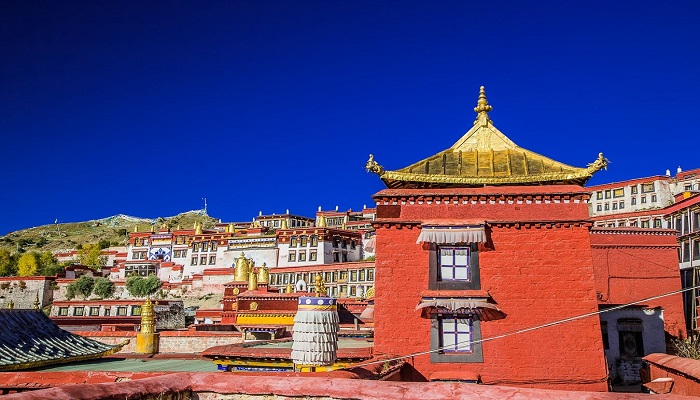
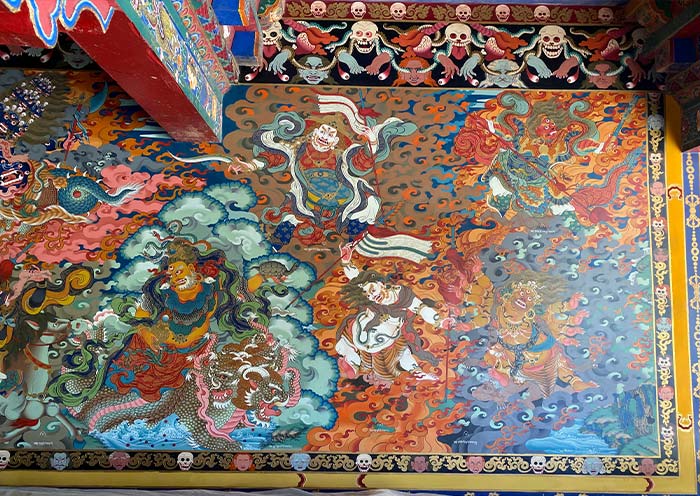
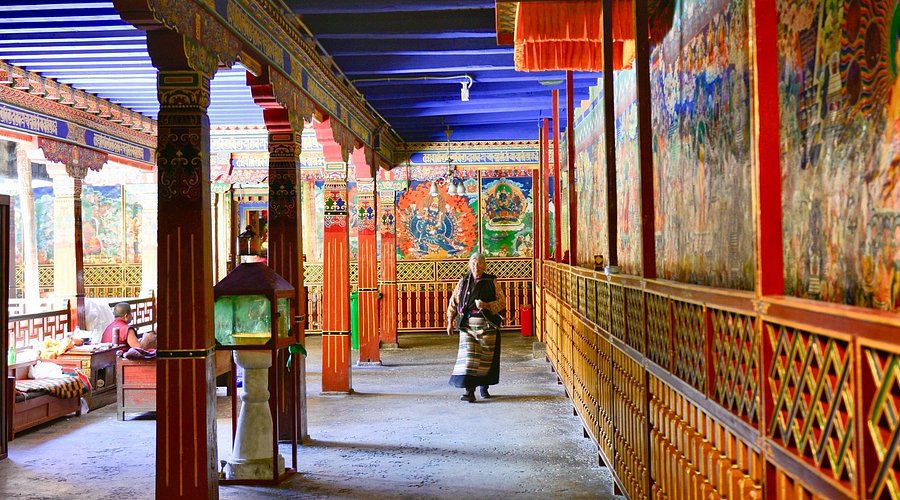
In addition to religious inheritance, Samye Monastery preserves a large number of precious cultural relics spanning more than 1,200 years, including ancient original murals, hand-carved Buddha statues, ancient sutra scrolls, and traditional religious ritual instruments. The magnificent murals in the halls record Buddhist stories, Tubo Dynasty history, and ancient Tibet folk customs, with exquisite painting skills and rich connotations, providing precious physical materials for the study of Tibet’s ancient society, religion, and art.
Modern Tourism Significance and Cultural Communication Value
Travel Guide and Visiting Experience
Today, Samye Monastery, Tibet’s first Buddhist temple, is not only a key national cultural relic protection unit in China but also a world-famous cultural tourism and pilgrimage resort. As a core part of a completeSamye Monastery Shannan Tibet travel guide, it is an essential destination for understanding the origin of Tibetan Buddhism and experiencing plateau Buddhist culture. Many travelers choose to Visit Samye Monastery from Lhasa for a one-day or two-day in-depth pilgrimage and cultural tour. Every year, tens of thousands of devout Tibetan believers come here for pilgrimage and prayer, inheriting the millennial Buddhist faith and continuing the ancient religious tradition.
Cultural Communication and Public Education Value
At the same time, a large number of global tourists, cultural researchers, and photography enthusiasts visit Samye Monastery Tibet to appreciate its unique integrated architectural art, feel the profound heritage of plateau civilization, and explore the origin and development context of Tibetan Buddhism. Unlike many modern scenic spots, it retains a strong original religious atmosphere, quiet and solemn, allowing every visitor to experience the power of ancient faith and cultural heritage.
As an important window for Tibet cultural communication, Samye Monastery has been committed to cultural inheritance and public education in modern times. It spreads the inclusive, peaceful, and benevolent core concepts of Buddhist culture to the world, showing the unique charm and profound historical heritage of Chinese Tibet traditional culture.
A Panoramic View of Samye Monastery
Frequently Asked Questions
Q: Why is Samye Monastery known as Tibet’s first Buddhist temple?
A: Samye Monastery is the first institutional Buddhist monastery in Tibet with complete Buddha, Dharma and Sangha. It was completed in 779 CE under King Trisong Detsen, where the Seven Trial Monks received the first official ordination in Tibetan history.
Q: What is special about Samye Monastery architecture?
A: Samye Monastery adopts a mandala layout simulating Buddhist cosmology. Its Utse Hall combines Tibetan, Han Chinese and Indian architectural styles, also known as the three‑style hall.
Conclusion: Eternal Sacred Status of Samye Monastery
To sum up, Samye Monastery occupies an irreplaceable supreme position in the history of Tibetan Buddhism and Tibet regional culture. As Tibet’s first Buddhist temple with complete religious system, standardized monastic inheritance, and unique cosmic architectural layout, it witnessed the official birth and steady development of institutional Buddhism in Tibet, and is an important witness of the integration of multi-ethnic and cross-border cultures in ancient China.
After more than 1,200 years of wind and rain, this ancient monastery standing on the bank of the Yarlung Zangbo River still retains its original solemnity and charm. It is not only a sacred place carrying the spiritual beliefs of generations of Tibet people but also a precious cultural heritage shared by the whole world, continuously spreading the profound, inclusive and peaceful cultural connotation of Chinese plateau civilization to all corners of the globe.