
Mount Everest can be climbed from two main sides: the South Col Route in Nepal and the Northeast Ridge Route in Tibet. Both reach the same summit, but the experience is remarkably different. Nepal offers the classic Khumbu approach, warmer conditions, and easier terrain near the summit, while Tibet provides a quieter base camp, easier road access, spectacular views of Everest, and a more technical upper route. The right choice depends on your priorities, climbing experience, tolerance for crowds, and preference for technical terrain.
Key Takeaways
- South Route, Nepal: Classic approach, warmer weather, extensive Sherpa support, but the Khumbu Icefall is a major objective hazard.
- North Route, Tibet: Quieter and easier to access by road, with spectacular Everest views, but stronger winds and more technical climbing at high altitude.
- Approach: Nepal requires a multi-day trek from Lukla, while Tibet allows climbers to reach Everest Base Camp by vehicle.
- Summit Terrain: The South Route is generally less technical on summit day; the North Route involves the famous Three Steps and more mixed climbing.
- Best choice: The South Route suits climbers prioritizing a classic Everest expedition and milder conditions; the North Route suits experienced climbers seeking a quieter, more controlled expedition environment.
Two Routes, Two Very Different Everest Experiences
Mount Everest does not simply have two routes to the same summit. The two sides offer almost completely different expedition experiences.
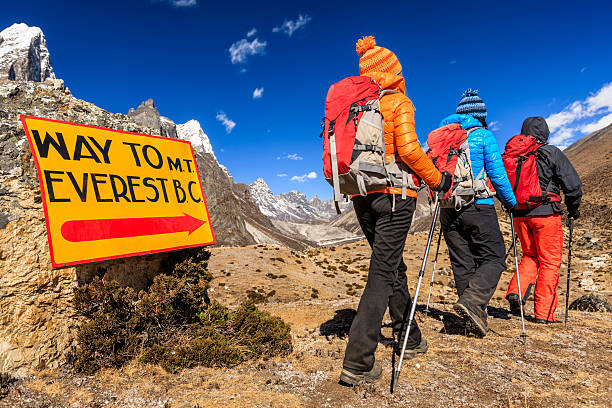
The South Col Route approaches Everest from Nepal through the Khumbu Valley. It is the route associated with the classic Everest Base Camp trek, Sherpa culture, the Khumbu Icefall, and some of the most recognizable images of an Everest expedition. Climbers begin their journey with a trek from Lukla and gradually work their way toward the mountain.
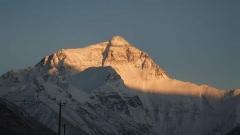
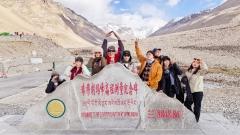
The Northeast Ridge Route approaches Everest from the Tibetan side of China. Instead of trekking for days through the Khumbu Valley, climbers can travel by road toward the northern base camp. The expedition environment is quieter, the base camp is less crowded, and Everest itself dominates the landscape from the northern side.
Neither route is simply “easy” or “hard.” Each presents different challenges. The South Side has greater exposure to the Khumbu Icefall and heavier crowds, while the North Side has stronger winds and more technical climbing at extreme altitude.
For climbers deciding between the two, the most useful question is therefore not simply “Which route is easier?” but “Which type of difficulty is better suited to me?”
Everest North Route vs. South Route: Key Statistics
The differences become clearer when looking at the expedition figures provided for the two routes.
| Feature | South Col Route, Nepal | Northeast Ridge Route, Tibet |
|---|---|---|
| Recorded summits | 9,156 | 3,728 |
| Recorded deaths | 225 | 98 |
| Base Camp elevation | 5,364 m (17,586 ft) | 5,150 m (16,896 ft) |
| Approx. route mileage | 20.5 km (12.5 miles) | 36.5 km (22 miles) |
| Total elevation gain | 3,484 m (11,443 ft) | 3,698 m (12,113 ft) |
These numbers should be understood as route statistics from the source material rather than as a direct measure of which side is “safer.” The routes have different histories, expedition numbers, climbing systems, and operating conditions.
The statistics do, however, highlight an important difference: the North Route involves a longer climbing line and slightly greater elevation gain, while the South Route has historically seen substantially more climbers.
That difference becomes particularly noticeable once you compare the approaches to base camp.
Approaching Everest Base Camp From Nepal
The Classic Khumbu Approach
For many mountaineers, the journey to Everest begins long before they reach the mountain itself.
On the Nepal side, climbers typically fly from Kathmandu to Lukla, located at approximately 2,860 meters (9,383 feet). The airport is famous for its short mountain runway and dramatic setting, making the arrival itself part of the adventure.
From Lukla, the traditional approach continues on foot through the Khumbu Valley. The trek generally takes around five to seven days, depending on the expedition schedule and acclimatization strategy.
The route passes through settlements, monasteries, suspension bridges, and traditional Sherpa communities. Climbers gradually gain altitude while spending nights in tea houses along the way.
This approach has an important advantage: it naturally contributes to acclimatization and physical conditioning.
Instead of arriving at high altitude immediately, climbers spend several days walking uphill and sleeping progressively higher. The journey also provides an opportunity to experience one of the world’s most famous mountain cultures.
The approach covers approximately 65 kilometers (40 miles) and gains about 2,504 meters (8,215 feet).
Advantages Of The South Approach
The Nepal approach offers several major advantages:
- Spectacular Himalayan scenery
- Rich Sherpa cultural experiences
- Gradual acclimatization
- Significant physical conditioning before the expedition
- The classic Everest Base Camp experience
For climbers who want their Everest expedition to feel like a complete Himalayan journey rather than simply an ascent, this approach is difficult to beat.
Disadvantages Of The South Approach
The traditional approach also has disadvantages.
The tea houses can become crowded, particularly during the main climbing season. Shared rooms and busy common areas may make quality sleep more difficult. Sanitation and hygiene can also be less consistent than in the hotels available on the Tibetan side.
The route is also increasingly busy, with trekking groups, expedition teams, helicopters, porters, and other visitors sharing the Khumbu region.
For some climbers, however, these disadvantages are part of the atmosphere that makes the Nepal side famous.
Mt. Everest South Col Route
Approaching Everest Base Camp From Tibet
A More Comfortable Road Approach
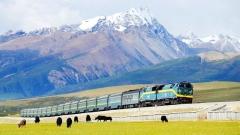
The northern approach is fundamentally different. Instead of beginning with a long trek from a mountain airport, climbers generally travel through Tibet toward Everest. The journey typically includes time in Lhasa, followed by travel toward Shigatse, Tingri, and eventually Everest Base Camp.
Lhasa sits at approximately 3,656 meters (11,975 feet), giving climbers an important opportunity to begin adapting to high altitude while also experiencing Tibetan culture. The journey can include visits to major cultural landmarks such as the Potala Palace before continuing toward the mountain.
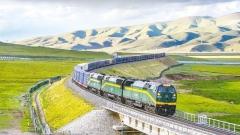
From Lhasa, the route continues toward higher-altitude destinations including Shigatse and Tingri. Much of the journey can be completed by road, making the northern approach considerably less physically demanding than the Nepalese trek.
The northern Everest Base Camp sits at approximately 5,150 meters (16,896 feet).
Advantages Of The North Approach
The Tibetan approach offers a very different kind of comfort. Climbers can stay in better-equipped hotels during the early stages of the journey, eat more comfortably, and use vehicles for much of the approach. The source material also highlights several facilities at the northern base camp, including electricity, 5G connectivity, and staffed kitchens.
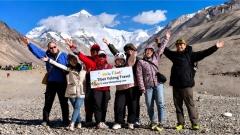
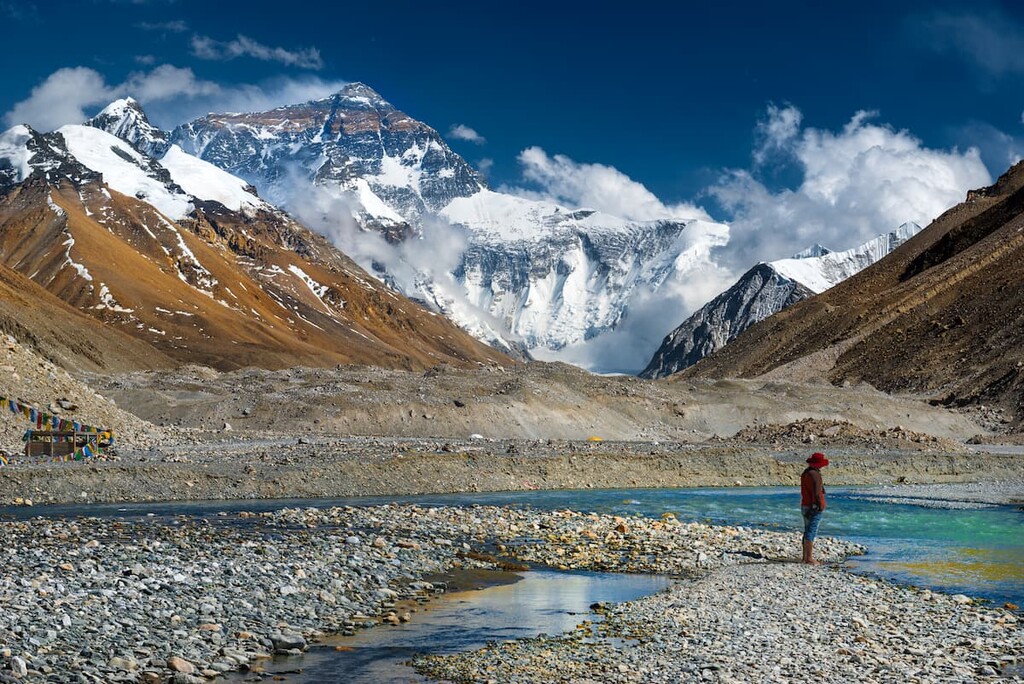
Another major advantage is the scenery. From the northern side, Everest rises dramatically above the surrounding landscape and can be viewed directly from base camp. For photographers and climbers who want to spend time simply observing the mountain, this is a major attraction.
Disadvantages Of The North Approach
The North Side is not automatically the easier option. The immigration and administrative procedures can be lengthy and stressful, and the route does not provide the same level of physical conditioning as the Nepal approach. Climbers arriving from Tibet therefore need to arrive already fit and properly prepared.
The weather is another important consideration. The northern side is more exposed to strong winds, particularly at higher elevations.
Northeast Ridge Route
Everest Base Camp: North vs. South
The differences become even more obvious once climbers arrive at base camp.
Crowds And Atmosphere
The South Side is much busier. The source material describes the Nepalese base camp as sometimes hosting more than 1,000 people. It is not exclusively an expedition camp; it is also part of one of the world’s most famous trekking destinations. The atmosphere can therefore be highly social and energetic, with numerous climbing teams operating simultaneously.
The North Side is considerably quieter. The source material estimates around 100–200 people at base camp and notes that access is more tightly controlled. For climbers who prefer privacy, organization, and a quieter environment, this can be a major advantage.
Helicopters And Noise
Helicopter operations are another major difference. On the Nepal side, helicopters are used for transportation and rescue. While this provides an important emergency option, it also creates considerable noise around base camp.
The North Side prohibits helicopters, producing a much quieter atmosphere. The trade-off is straightforward: Nepal offers greater helicopter access, while Tibet offers greater peace and quiet.
Amenities And Connectivity
Both sides provide basic expedition infrastructure, but the source material describes the northern base camp as having particularly strong connectivity and electrical infrastructure.
The North Side has grid electricity and 5G service, while the South Side relies more heavily on solar-generated electricity and has less reliable internet.
For a long expedition in which communication with the outside world matters, this difference may be significant.
The South Col Route: What The Climb Is Like
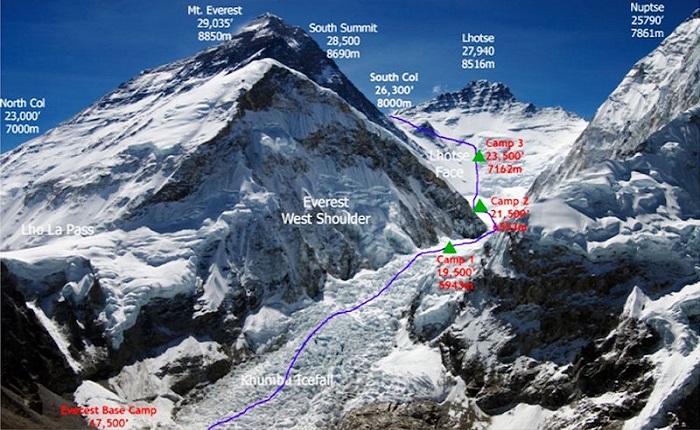
The South Col Route begins with one of Everest’s most notorious obstacles: the Khumbu Icefall.
The Khumbu Icefall
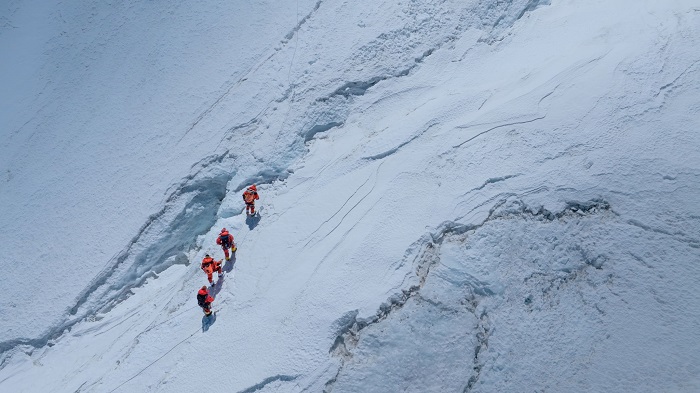
The Khumbu Icefall is constantly changing. Massive blocks of ice can shift, fracture, and collapse, creating one of the most significant objective hazards on the South Route. Sherpa teams maintain ladders and fixed ropes through the icefall, allowing climbers to negotiate crevasses and steep sections.
Most climbers pass through the icefall during acclimatization rotations and again during the summit attempt. Experienced Sherpa climbers may cross it many more times. Crowding adds another dimension to the problem. When many climbers are attempting to pass through the same technical terrain, bottlenecks can develop.
This is one of the strongest arguments against the South Route for climbers who prioritize minimizing objective hazards.
Camp 1 And Camp 2
After passing through the icefall, climbers reach Camp 1 and continue across the Western Cwm toward Camp 2. The terrain here is generally more straightforward glacier travel, although crevasses and fixed lines remain important considerations.
Camp 2 serves as an important staging point before climbers tackle the steep terrain above.
Camp 3 And The Lhotse Face
The route then climbs the Lhotse Face, where the angle reaches approximately 35–45 degrees. The climbing is primarily on steep snow and ice, with fixed ropes providing protection.
Above this section, climbers encounter the Yellow Band and Geneva Spur before reaching Camp 4 at the South Col.
Summit Day From The South
The summit push passes through the Death Zone, above 8,000 meters. Important landmarks include the Balcony, South Summit, Cornice Traverse, and Hillary Step.
One advantage of the South Route is that the terrain on summit day is generally less technically demanding than the upper North Route. Much of the route consists of snow climbing, with fewer mixed rock-and-ice sections. The South Route also benefits from stronger support infrastructure and the possibility of helicopter rescue at lower elevations, depending on weather and conditions.
However, the summit day begins from a lower elevation than the North Route, making the final push longer.
The Northeast Ridge Route: What The Climb Is Like
The Tibetan route begins from Rongbuk Glacier and follows a long but relatively gradual approach toward the higher camps.
Intermediate Camp And Advanced Base Camp
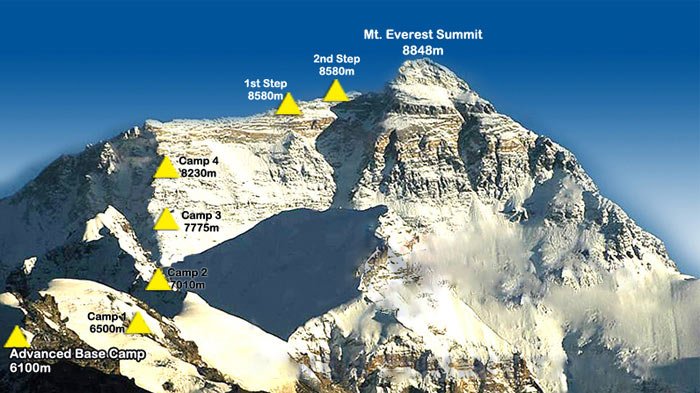
The initial route from Everest Base Camp toward Intermediate Camp is comparatively gentle. From there, climbers continue toward Advanced Base Camp at approximately 6,400 meters (21,000 feet).
ABC becomes an important acclimatization location, with teams commonly spending several nights there before moving higher.
The North Col
From Advanced Base Camp, climbers ascend steep snow and ice toward the North Col at approximately 7,000 meters (22,965 feet). Fixed ropes are used on the steeper sections.
The North Col becomes the first major high-altitude camp and an important staging point for the upper mountain.
The North Ridge And High Camps
Above the North Col, the route follows the exposed North Ridge toward Camp 2 at approximately 7,600 meters. The route continues upward to Camp 3 at approximately 8,300 meters (27,230 feet).
At these elevations, the environment becomes extremely demanding. Strong winds can be a major problem, while the combination of altitude, cold, and exposure makes even relatively short movements physically exhausting.
The Three Steps
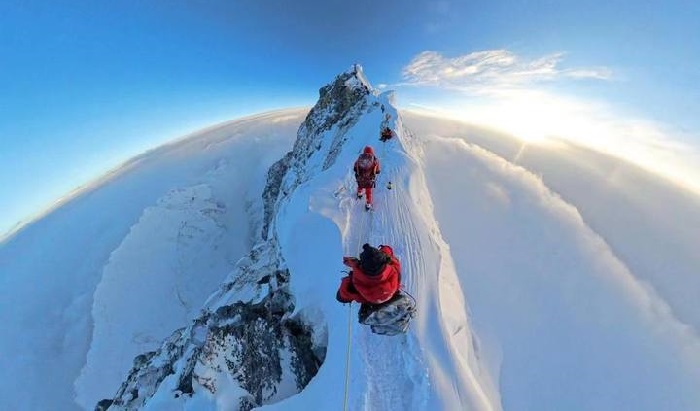
One of the defining features of the North Route is the series of three rock steps encountered during the summit push. The Second Step is particularly famous because of its steep, technical nature at an extreme altitude. Climbers must combine rock-climbing technique with efficient movement in crampons and fixed ropes. After negotiating the Three Steps, the route continues toward the summit ridge.
Unlike the South Route, the North Route’s summit sequence does not involve the same series of false summits described on the southern side. The experience is therefore highly technical, exposed, and demanding—but also exceptionally rewarding for climbers with the appropriate skills.
North Route Vs. South Route: Which Is Safer?
Safety is one of the most important considerations when choosing an Everest route. There is no route that can make Everest safe. At more than 8,000 meters, climbers face severe altitude, extreme cold, unpredictable weather, falling rock and ice, exhaustion, and the possibility of life-threatening emergencies.
However, the types of hazards differ significantly. The South Route’s major concern is the Khumbu Icefall. It is an objective hazard: the climber cannot control when a serac collapses or when the glacier shifts. The North Route avoids the Khumbu Icefall but exposes climbers to stronger winds and more technical climbing at extreme altitude. The North Side also does not provide the same helicopter rescue option available on the Nepal side.
Therefore, choosing between the routes requires understanding what kind of risk you are better prepared to manage.
North Route Vs. South Route: Which Is Easier?
This question is more complicated than it first appears.
The approach to base camp is easier from Tibet because vehicles can take climbers close to Everest Base Camp. The upper climbing terrain is generally easier from Nepal, particularly after passing the Khumbu Icefall.
The South Route has more snow-dominated climbing during the upper sections, while the North Route requires more technical movement over rock, snow, and ice at extreme altitude.
A climber with strong technical climbing skills may appreciate the North Route. Someone who is more comfortable with snow and glacier travel may prefer the South Route.
In other words, neither side is universally easier. The easier route depends on which challenges match your experience.
North Route Vs. South Route: Weather And Environment
Weather may be the strongest argument in favor of the Nepal side.
The South Side is generally warmer and less exposed to the strongest winds. The North Side can experience severe wind, especially around the upper camps and exposed ridge. This difference matters enormously at extreme altitude.
A strong wind does not merely make a climb uncomfortable. It can significantly increase heat loss, affect tent stability, reduce visibility, and make movement on exposed terrain more difficult.
For climbers choosing the North Route, therefore, weather forecasting and flexibility are especially important.
Which Everest Route Should You Choose?
Choose The South Route If You Want The Classic Everest Experience
The South Side may be the better choice if your priority is the traditional Everest expedition experience. You will trek through the Khumbu Valley, experience Sherpa communities, gradually acclimatize on foot, and approach the mountain through the famous southern base camp.
The route is also generally warmer and less windy. Its major disadvantages are the crowds, the Khumbu Icefall, and the associated objective hazards.
Choose The North Route If You Value Quiet And Technical Climbing
The North Side may be more suitable for climbers who prioritize a quieter expedition environment and easier access to base camp. The road approach reduces the physical demands of reaching Everest Base Camp, while the northern base camp provides extraordinary views directly toward the summit.
However, climbers must be comfortable with stronger winds and technically demanding mixed terrain at very high altitude. The North Route is particularly attractive to experienced mountaineers who want a more controlled and less crowded expedition environment.
What Experience Do You Need To Climb From Tibet?
The North Route should not be treated as an ordinary trekking route. The source material indicates that climbers choosing the Tibetan side should have significant high-altitude experience and strong technical skills.
Experience above 7,000 meters is particularly relevant, while previous expeditions above 8,000 meters provide valuable preparation for the demands of Everest.
Climbers should be comfortable with:
- Ascenders and fixed ropes
- Crampon movement
- Snow and ice climbing
- Mixed rock and ice terrain
- Rappelling
- Extreme cold
- High-altitude camp life
- Long summit pushes
- Oxygen systems
- Emergency procedures
Physical fitness alone is not enough.
A person can be an excellent runner, cyclist, or gym athlete and still be poorly prepared for Everest. The mountain demands a combination of cardiovascular endurance, muscular strength, technical climbing ability, altitude experience, and psychological resilience.
Preparing For An Everest Expedition
Build Climbing-Specific Fitness
Training should focus on climbing rather than general fitness alone.
A strong preparation program should progressively develop:
- Uphill hiking with a loaded pack
- Lower-body strength
- Aerobic endurance
- Anaerobic capacity
- Balance and movement efficiency
- Technical climbing skills
- Altitude experience
Many climbers need approximately a year of dedicated preparation, building from an already solid fitness foundation.
Training volume should increase gradually. Increasing hiking distance, elevation gain, and pack weight too quickly can create injuries before the expedition even begins.
Develop High-Altitude Experience
Everest is not the mountain on which to discover how your body responds to extreme altitude for the first time. Prior experience at progressively higher elevations can help climbers understand their own acclimatization patterns and identify potential problems before attempting an Everest expedition.
Technical competence is equally important. The ability to use fixed ropes efficiently, climb in crampons, ascend and descend safely, and move confidently on mixed terrain becomes especially important on the North Route.
Travel Documents For The Tibetan Route
Because the northern side of Everest is in Tibet, international climbers need the appropriate Chinese and Tibetan travel documentation. The source material identifies the Tibet Travel Permit, Alien’s Travel Permit, and mountaineering permit among the required documents.
International travelers also need to participate in an organized itinerary through a registered travel agency and travel with the required Tibetan mountain guide and expedition support. These arrangements should be made well in advance because Everest expeditions involve considerably more logistical planning than ordinary Tibet tours.

Tibet Travel Permit – Tibet Yulong
Final Verdict: North Route Or South Route?
There is no single winner in the Everest North Route vs. South Route debate.
The South Route is the classic Everest experience. It offers the legendary Khumbu approach, Sherpa culture, warmer conditions, and generally less technical terrain during the summit push. Its greatest weaknesses are crowding and the objective dangers of the Khumbu Icefall.
The North Route offers a quieter and more controlled expedition environment. Its road access, spectacular views from base camp, modern connectivity, limited crowds, and avoidance of the Khumbu Icefall are major advantages. However, stronger winds and more technical climbing on the upper mountain make it a serious challenge that demands appropriate experience.
For climbers who want the traditional Himalayan expedition and value warmer conditions, Nepal’s South Col Route remains an extraordinary choice.
For experienced mountaineers who prefer fewer people, easier access to base camp, spectacular northern views, and a technically demanding summit route, Tibet’s Northeast Ridge can be the more compelling option.
If you are planning an Everest expedition from the Tibetan side, Tibet Yulong can assist international travelers with the necessary Tibet travel arrangements, permits, transportation, local logistics, accommodation, and expedition support. Working with a Tibet-based team can make the complicated administrative and logistical side of an Everest expedition much easier to manage, allowing climbers to concentrate on what matters most: preparation, acclimatization, and the mountain itself.