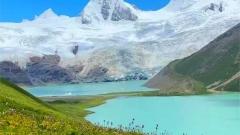
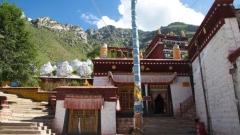
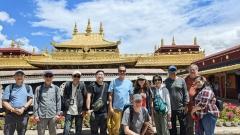
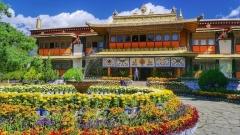
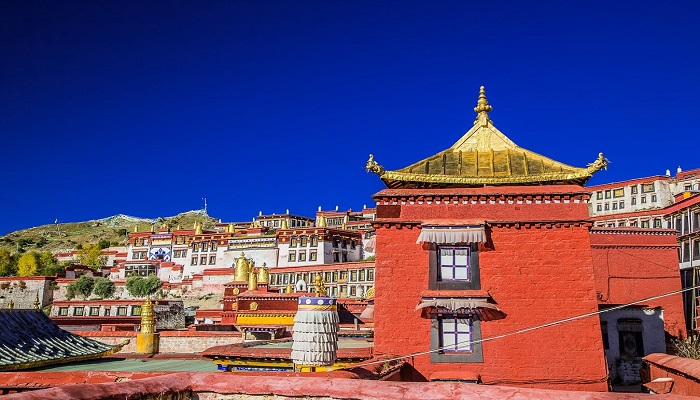
✨Highlights:
- 🛕 Start at Ganden, the monastery Tsongkhapa founded in 1409 and the head of the Gelug order
- 🥾 A relaxed 3.5-day trek of about 46 km through the hills between Ganden and the Yarlung valley
- ⛰️ Cross the Shug La and the Chitu La, both above 5,000 metres, with the Himalaya on the horizon
- ⛺ Camp on herder pastures beside the Tsotup Chu, with yaks carrying camp and cooks preparing hot meals
- 🌸 Finish through the trek’s most beautiful stretch: scrub forest, rhododendron and alpine meadow
- 🏯 Arrive at Samye, Tibet’s first Buddhist monastery, laid out as a three-dimensional mandala
- 🙏 Optional kora up Hepori Hill for the classic view over Samye’s mandala plan
- 🏛️ All three great Gelug monasteries plus the Potala, the Jokhang and the Barkhor in the same trip
A trek that connects two ends of Tibetan history
Ganden and Samye are eight centuries apart and about 45 kilometres from each other as the crow flies. Ganden, founded by Tsongkhapa in 1409, is the mother monastery of the Gelug order, the school that came to dominate Tibetan monastic life. Samye, built in the eighth century, is the first Buddhist monastery in Tibet, designed as a mandala with the main temple at the centre representing Mount Meru and the surrounding chapels representing the continents.
Walking between them is the best possible way to understand how Tibetan Buddhism spread: from an imported monastic experiment in the Yarlung valley, through centuries of teaching and reform, to an institution that could house ten thousand monks outside Lhasa. The route crosses two passes above 5,000 metres, follows the Tsotup Chu through herder country, descends into forest and rhododendron, and ends on the plain where the first temple was built.
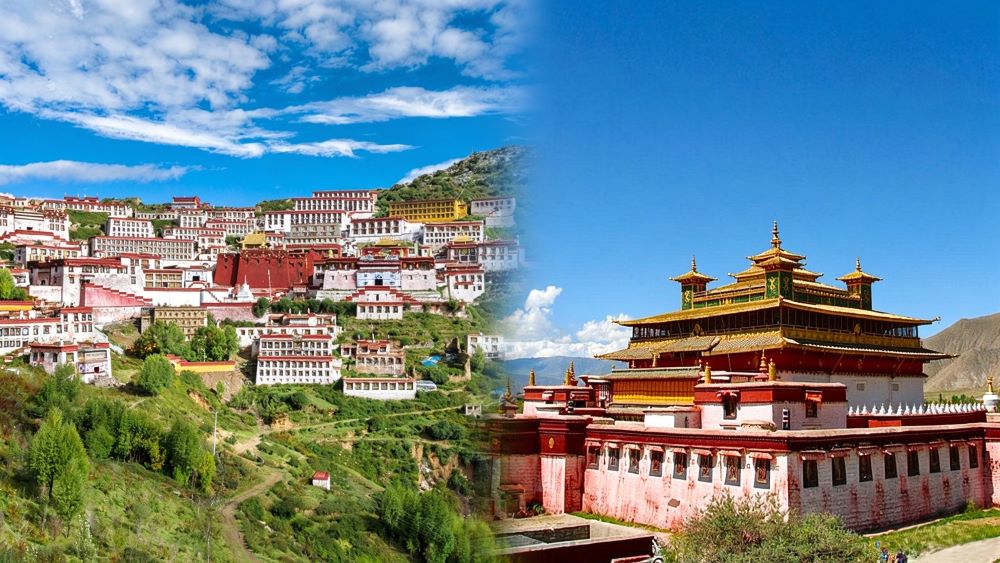
Trek from Ganden to Samye Monastery
The Ganden to Samye trek is a classic for a reason: it is well supported, logistically simple, culturally dense and not brutally long. Three and a half days of walking, camps that are pitched for you, and a finish in one of the most important sites in Tibet.
At a glance
- Duration: 9 days and 8 nights from Lhasa, including 3.5 trekking days
- Trekking distance: about 46 km on foot, plus a 24 km vehicle transfer on the final trek day
- Highest point: the Shug La, above 5,000 metres; the Chitu La is also above 5,000 metres
- Sleeping: three nights in tents on pasture, then guesthouses in Samye and hotels in Lhasa
- Difficulty: moderate; suitable for regular hikers with some altitude experience
- Best months: May to early June, and September to mid-October
- Group size: 2 to 12 travellers, private departures available
- Support: licensed guide, cook crew, pack yaks, twin tents and all camp equipment
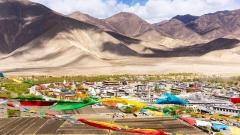
Who this trek suits, and who should choose otherwise
The Ganden to Samye trek is the best first Himalayan trek for travellers who want culture and walking in roughly equal measure. It suits hikers who are comfortable with six to seven hours on rough ground, who have camped before or are willing to try, and who would rather finish at a fourteenth-century monastery than at a viewpoint car park. It also suits travellers with limited time: nine days from arrival to departure, with three and a half of them on foot, is a compact way to see both the Gelug heartland and the Yarlung valley.
It does not suit travellers who want a lodge-to-lodge trek with hot showers every night, or who have never slept above 4,000 metres and are uncertain how they will react. It also does not suit anyone hoping for an easy walk: the two passes and the boulder descents are real work, and the descent from the Shug La demands attention for a couple of hours.
If you are unsure whether you are ready, the honest test is simple. Can you walk uphill for two hours without stopping, at home, carrying five kilos? Can you sleep in a tent in cold weather and still enjoy the following day? If both answers are yes, this route will treat you well.
Day 1: Arrival in Lhasa at 3,650 metres
The usual welcome: a guide with a white hada at the airport or railway station, a drive into the city past the Lhasa River, and a hotel with oxygen supply and humidifiers. The rest of the day is for resting. Avoid the hot shower, avoid the celebratory beer, and go to bed early; Lhasa punishes enthusiasm more than it punishes laziness.
Day 2: Drepung and Sera Monastery, the two halves of monastic training
Drepung in the morning, the white hillside complex that was once the largest monastery in Tibet, with its Coqen Hall and the Loseling College dormitories where study continues in rooms the size of a wardrobe. Then Sera in the afternoon for the debates, held from 15:30 to 17:00, Monday to Saturday, in the courtyard below the assembly hall.
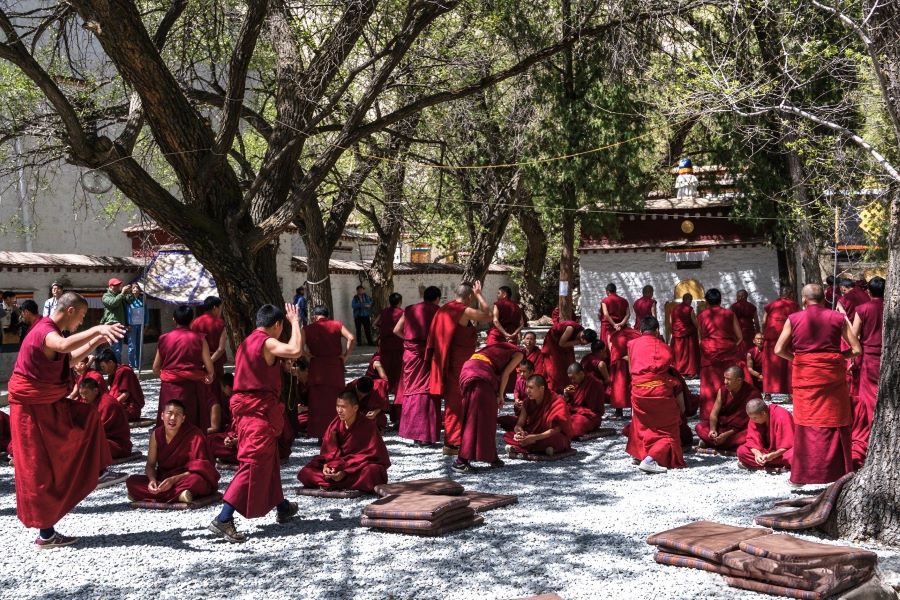
Lamas at Sera Monastery Engage in Debate
In the evening, free time in the old town. Lhasa after dark is a different city: pilgrims still circling the Barkhor, shops lit up, tea houses full, and the Potala floodlit on its hill.
Day 3: Potala Palace, Jokhang Temple and the Barkhor
The two UNESCO sites in one day. The Potala first, climbed slowly, with its chapels, murals, gilded stupas and the cave associated with Songtsen Gampo. Then Longwangtan Park for the reflection shot, lunch, and the Jokhang in the afternoon, with its Jowo Shakyamuni image and its prostration ground.
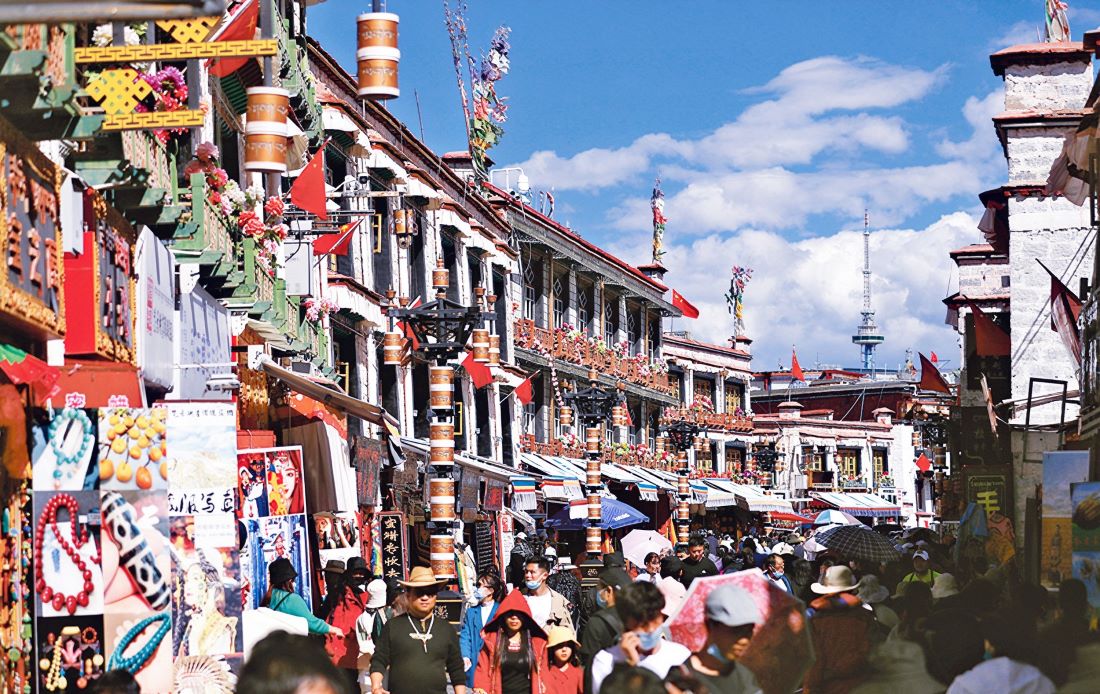
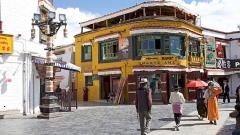
Barkhor Street
The Barkhor circuit closes the day: clockwise, past prayer wheels and stalls, with pilgrims and shoppers in the same current. Finish in a tea house. Tomorrow the walking starts.
Day 4: Ganden Monastery, then trek to Yama-do
An early drive east, about seventy kilometres, following the Kyichu River. Ganden appears on its ridge long before you reach it: a long white and gold complex draped across the crest, visible for kilometres. Inside, tour the assembly hall and the stupa of Tsongkhapa, the reformer whose teachings shaped the Gelug school.
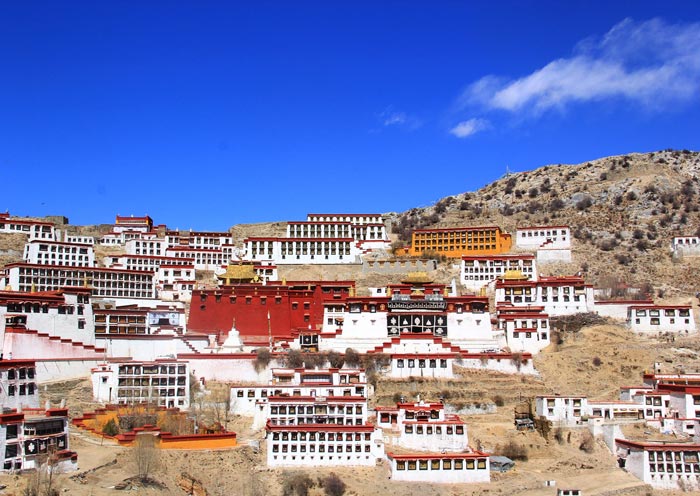
Ganden Monastery
Then to Tsubshi Village to arrange the pack yaks, and the trek begins with a gentle uphill walk of about 7 km to Yama-do, taking two to three hours. It is a soft introduction on purpose: enough climbing to warm the legs, not enough to punish them. Camp is pitched and dinner is waiting when you arrive.
Day 5: Over the Shug La into the Tsotup Chu valley, 10 km
The day starts at the valley bottom and climbs a steep ravine beside a stream. Then the Shug La, the high point of the trek above 5,000 metres, where the trail is rough and the views open in every direction. The descent is careful work across boulder fields, slow and deliberate, with poles helping.
At the bottom, you cross the Tsotup Chu, a proper river winding through the valley, and camp on a pasture used by local herders at around 4,300 metres. Expect yaks, a herder’s tent or two, and the sound of running water all night.
Day 6: Upstream to the herder’s camp, 14 km
Following the Tsotup Chu and its tributaries upstream, the trail climbs to the Chitu La, another pass above 5,000 metres, rocky and exposed. Beyond it, a fast descent leads into quiet herder settlements, and about an hour of easy walking brings you to a campsite beside a stream.
This is the day the trek starts to feel remote. No villages, no traffic, no sound but bells and water. The cooks will have tea ready before you have taken your boots off.
Day 7: Forest, rhododendron and the drive to Samye, 15 km
Today’s route is 39 km in total, of which 15 km are on foot and 24 km by vehicle. The path broadens and gentles as it follows the main valley into scrub woodland, past clear streams and, in late spring and early summer, flowering rhododendron. Many trekkers call this the most scenic stretch of the whole route: more than fifteen shrub varieties, meadows, and the first real trees in days.
You pass through Changtang Village, and can take an optional hour-long side trip to Yamalung Hermitage, an ancient meditation retreat tucked into the hillside. Then the vehicle collects you and drives to Samye, where you sleep in a local guesthouse.
Day 8: Samye Monastery and the Hepori kora
Samye is the reason this route matters historically. Built in the eighth century, it is the first Buddhist monastery in Tibet, and its plan is a mandala: the three-storey main hall stands for Mount Meru at the centre of the Buddhist cosmos, the four directional chapels represent the great continents around it, and the smaller temples beside each chapel stand for the outlying islands.
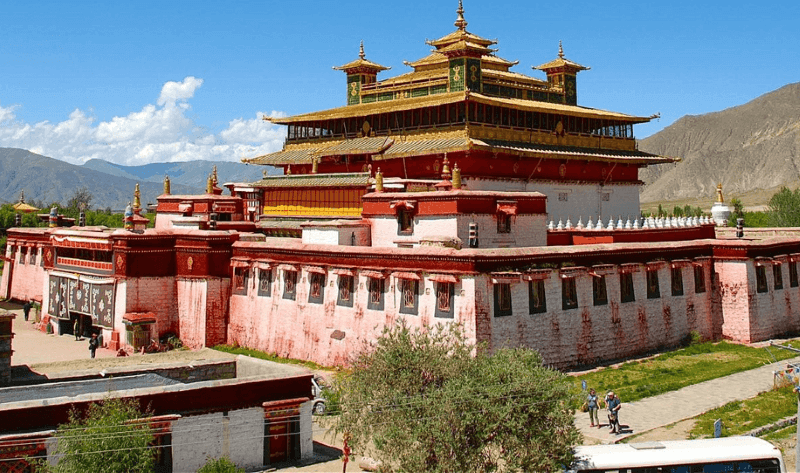
Samye Monastery
Climb to the roof of the main hall for the view of the whole layout, then walk the complex slowly. If time and energy allow, the kora up Hepori Hill behind the monastery takes about an hour up and gives you the photograph that explains Samye better than any diagram: the mandala in plan, the Yarlung river behind it, and the dunes and farmland beyond.
Overnight in Samye town beside the Yarlung valley.
Day 9: Back to Lhasa and out
A morning free in Samye, then the drive back to Lhasa and onward transfer to the airport or station. Depending on your flight time, an extra night in Lhasa can be added.
What the walking is like, day by day
The Ganden to Samye trek is a moderate route with three genuinely demanding days. Distances are short (7, 10, 14 and 15 km), but two passes above 5,000 metres and boulder descents make the effort real. Trail conditions vary from compact dirt to loose scree to river crossings on stones. There is no exposure and no technical ground, but there are sections where a misplaced step would mean a turned ankle, so poles and care are worth the weight.
Camps are on pasture at around 4,300 to 4,500 metres, with tents pitched by the crew and meals prepared by a cook. Nights are cold: expect close to freezing even in summer, and below minus five in October. A sleeping bag rated to minus fifteen is the single item that determines whether you sleep.
Culture along the way: three monasteries, one story
Ganden represents the institutional peak of Tibetan Buddhism: a monastery founded by a reformer, organised around rigorous study, and powerful enough to shape the political history of the plateau. Samye represents its beginning: an imperial project, built with Indian and Chinese teachers, designed as a mandala on the ground.
Between them, the trek passes herder settlements and small hermitages where practice is quieter and less documented. That is the third layer of the story: the tradition as it is actually lived, by people moving yaks across passes in the same season their ancestors did.
Altitude and how the itinerary handles it
Three nights in Lhasa at 3,650 metres precede the first camp, which is the single most effective acclimatisation measure available. The trek then climbs gradually: Yama-do, then the Shug La above 5,000, then the Chitu La. Symptoms to take seriously are a headache that will not respond to paracetamol, nausea, vomiting, confusion, unusual breathlessness at rest and a persistent cough. Tell your guide immediately; do not wait for the morning.
We carry portable oxygen, the guide carries a pulse oximeter, and the route has road access at Ganden and at Samye, with vehicle support available on the last trek day.
Best season
Late May and June bring green pasture, running streams and flowering rhododendron, with afternoon cloud building most days. July and August are warmer but wetter, with muddy trails and leeches in the lower forest after rain. September and October are the best months: stable air, clear views from both passes, golden grass and cold nights. Trekking is not advisable in winter, when the passes hold snow and the herder camps empty.
Permits and practical details
The Tibet Travel Permit is required for all foreign travellers and must be arranged through a licensed local agency; we handle the application and tell you which documents to send. The itinerary includes a private 9 to 17 seat vehicle with driver, a licensed guide, all entrance fees for listed sites, airport or station transfers, four-star or equivalent hotels in Lhasa with breakfast, guesthouses in Samye, tents, cooking equipment, camp meals on trek days, pack yaks, portable oxygen and bottled water. Not included: travel to and from Lhasa, meals not listed, personal expenses, tips, single supplements and any hotel upgrades.
Food, water and camp comfort
Camp meals are simple but warm: tea and porridge in the morning, a packed or cooked lunch, soup, rice, vegetables and protein at dinner. Vegetarian requirements are easy; tell us at booking. Water is boiled and supplied; carry a filter bottle as back-up. There are no showers for three nights, though hot water for washing is provided.
Fitness and packing
Train with hills and stairs for six to eight weeks beforehand, and if possible do one multi-day walk at moderate altitude. Pack a duffel for the yaks (about 15 kg), a daypack for you, waterproof shell, fleece, down jacket, warm hat, gloves, sunglasses, sunscreen, lip balm, headtorch, water bottle, poles, and a bag liner. Bring cash in small notes for tea and offerings in Samye.
Travelling respectfully
Ask before photographing herders, monks and children. Do not enter a herder’s tent uninvited; if invited, sit where you are shown and accept tea with both hands. Walk clockwise around monasteries and stupas. Do not leave rubbish at camps; pack out everything, including food scraps and wet wipes. Keep group sizes small, stay on trails across pasture, and never disturb livestock or dogs.
FAQ
How hard is the Ganden to Samye trek compared with Everest Base Camp?
It is shorter and lower, with two passes above 5,000 metres and distances under 15 km per day. Most hikers find it moderate rather than challenging, though the boulder descents demand care.
Can I do the trek without camping experience?
Yes. Tents, mats and meals are provided, and the crew pitches camp. You need a suitable sleeping bag and a willingness to be cold at night.
Do I need to carry my own pack?
No. Yaks carry the camp and your duffel; you walk with a daypack.
Is Samye Monastery still active?
Yes. It is a working monastery and an important pilgrimage site, so behave as you would in any active place of worship.
What happens if the passes are snowed in?
In the shoulder seasons, the guide may reroute or transfer part of the group by vehicle. This is decided locally on the day, with safety as the only criterion.
How many nights in tents?
Three: Yama-do, Tsotup Chu valley and the herder’s camp. The fourth night is in a guesthouse in Samye.
Trek from Ganden to Samye with Tibet Yulong
Tibet Yulong is a locally owned operator with Tibetan guides who have walked this route in every season. We arrange the permits, the yaks, the cooks and the timing, and we keep groups small enough that a herder’s pasture still feels like one. Send us your dates and your trekking experience, and we will tell you which season gives you the clearest passes and the best rhododendron.