
Sakya Monastery is known for its imposing architecture, extensive historic collections, and richly decorated interiors. Its wall paintings reward a slower visit: instead of treating them as background decoration, look at how figures, colors, gestures, and architectural details work together. This Sakya monastery wall painting viewing guide explains what to notice, how to prepare, and how to behave inside sacred spaces. It also offers practical context for travelers visiting Sakya in Tibet, where altitude, travel time, and local rules can shape the day as much as the art itself.
- Look for the story within each painted scene.
- Notice figures, gestures, colors, and borders.
- Confirm photography rules before taking pictures.
- Allow time for altitude and a measured visit.
- Explore Sakya with respect for local customs.
Why Sakya’s wall paintings deserve a closer look
Sakya Monastery is the principal seat of the Sakya school of Tibetan Buddhism and one of the most significant religious sites in the town of Sakya, in present-day Xigazê Prefecture. The monastery complex is associated with a long history of religious learning, artistic patronage, and political influence. Its buildings and collections reflect different periods of activity, so the experience is not limited to a single room or style.
The painted walls are part of a living religious setting. They may depict Buddhist figures, teachers, protective deities, mandalas, or scenes arranged according to established religious traditions. Not every image is meant to be read like a standalone portrait. A figure’s position, hand gesture, attributes, color, and relationship to neighboring figures can all contribute to its meaning.
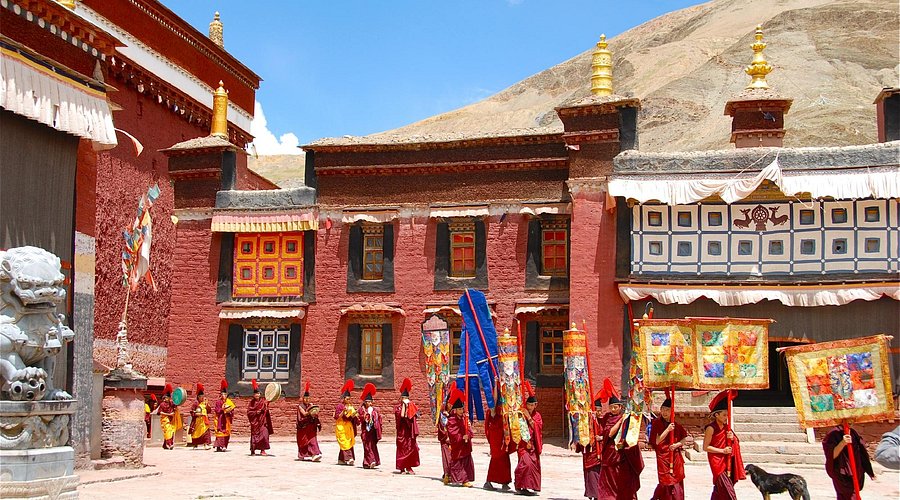
Sakya Monastery
Condition, lighting, and access vary from one interior to another. Some paintings may be difficult to see in dim rooms, and access to particular spaces can depend on monastery rules or the day’s activities. Treat this guide as a way to observe more thoughtfully rather than as a promise that every visitor will see the same rooms or artworks.
A short background to Sakya Monastery
The monastery is closely connected with the Sakya tradition, one of the major schools of Tibetan Buddhism. The name “Sakya” is often associated with the pale earth-colored landscape near the monastery. The complex has developed over centuries, and its architecture reflects the importance of the religious institution as well as the needs of worship, teaching, and community life.
Sakya Monastery is commonly discussed as having distinct northern and southern parts, with the southern complex standing out for its fortified appearance. The site’s layout and the surrounding settlement help visitors understand that this is not simply a museum. It remains a place of religious practice, and people may be praying, studying, or carrying out daily duties while visitors are present.
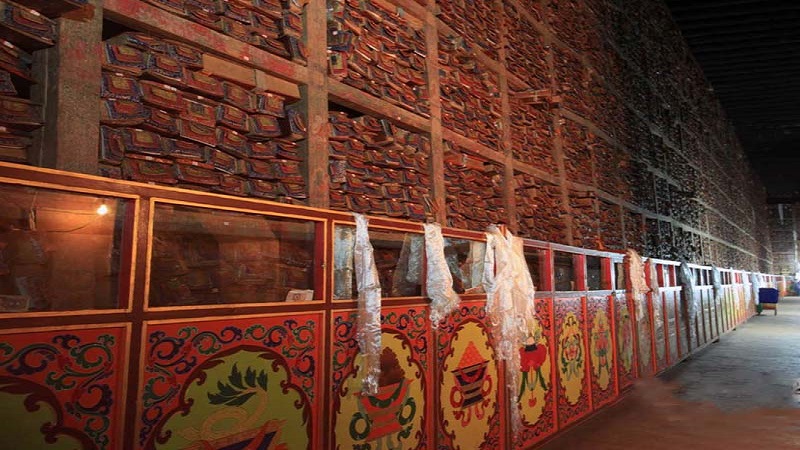
The monastery is also well known for its library and collections of religious texts. These collections help place the wall paintings in a wider cultural setting: painting, sculpture, manuscripts, architecture, and ritual belong to connected traditions. The precise history of an individual painting can be difficult to establish without specialist interpretation, so avoid assigning a date or maker based on appearance alone.
Sakya monastery wall painting viewing guide: how to read a room
A useful approach is to begin with the room as a whole. Pause at the entrance, allow your eyes to adjust, and notice how the painted surfaces relate to the space. Is the decoration concentrated around an altar, arranged in horizontal bands, or spread across several walls? Are there painted borders that divide one scene from another? This first impression can reveal how the room is organized before you focus on individual details.
Then move your attention from the largest elements to the smallest. Identify the central figure or focal area, if there is one. Look for figures placed above, beside, or below it. The composition may indicate hierarchy, a teaching lineage, a mandala structure, or a narrative sequence. A central figure is not always the only important one; attendants, teachers, and protective figures can be essential to understanding the scene.
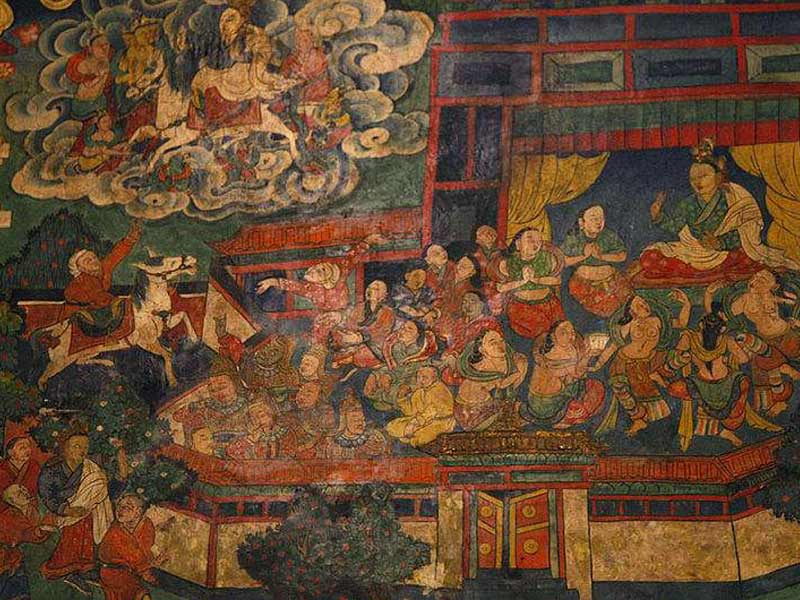
Magnificent Wall Murals
Keep a comfortable distance from the wall. Paintings are vulnerable to physical contact, changes in humidity, and other forms of wear. Do not lean against painted surfaces or try to get close enough to inspect details if doing so would obstruct worshippers or cross a boundary. If a room is crowded, wait for a quieter moment or focus on another section.
Start with the overall composition
Look for visual order before trying to identify every figure. Many Tibetan Buddhist paintings use deliberate arrangements rather than naturalistic perspective. Repeated shapes, symmetrical groupings, and enclosing circles or squares may signal a structured religious image. Narrative scenes, by contrast, may use several episodes or groups of figures within one painted field.
Notice whether the painted architecture echoes the real room. Painted columns, canopies, frames, and architectural settings can create a symbolic space within the physical one. A border may separate scenes, emphasize a central subject, or imitate a textile or decorative frame. These details are easy to miss when visitors look only for famous figures.
Read gestures and attributes cautiously
Hand gestures, known as mudras in Buddhist art, can communicate teaching, meditation, protection, generosity, or other ideas. Objects held by a figure may also help with identification. However, similar-looking gestures and attributes can appear in different contexts. If you are uncertain, describe what you see rather than confidently naming a figure without support.
A guide or reliable interpretive material can help explain local identifications. When no explanation is available, focus on observable features: the figure’s posture, the number of arms, the objects held, the color of the body, and its position in the composition. This makes the visit more rewarding without turning a guess into a claim.
Notice color and painted borders
Color can carry religious and visual significance, but it also reflects artistic choices and the condition of the surface. Look at how contrasting colors distinguish figures, clothing, backgrounds, and decorative borders. A repeated palette may connect different parts of a scene, while a bright central area can draw attention to a principal subject.
Do not assume that every color has one fixed meaning across all images. Interpretation can depend on the figure, tradition, context, and artistic program. It is often more useful to observe how color functions in the composition than to search for a simple one-to-one explanation.
What to look for in different kinds of scenes
The paintings at a Tibetan Buddhist monastery may include a broad range of subjects. The following categories are useful starting points, not a guarantee that every type will be visible in every room.
Teachers and lineage figures
Paintings may represent teachers and spiritual lineages, sometimes arranged in rows or around a central figure. Pay attention to how each person is positioned and whether figures hold books, ritual objects, or other attributes. These portraits can express the transmission of teachings, so their arrangement may matter as much as the identity of any single teacher.
Buddhas, bodhisattvas, and other sacred figures
A large central figure may be surrounded by smaller beings, attendants, or symbolic elements. Observe the balance between the central image and the surrounding figures. Notice the throne, halo, clothing, ornaments, and hand position, but avoid assuming that size alone identifies a figure’s status or meaning.
Protective deities and vivid imagery
Some religious images are deliberately intense, with strong colors, dynamic poses, or multiple arms. Such forms can be unsettling to visitors unfamiliar with Tibetan Buddhist iconography. They belong to specific religious contexts and should not be reduced to “monsters” or decorative curiosities. Observe the images calmly, and ask a qualified guide for context when available.
Mandalas and ordered designs
A mandala is a structured image associated with religious practice and symbolism. It may contain concentric forms, gates, figures, and carefully balanced divisions. If you encounter a mandala painting, take in the complete design before focusing on individual sections. Moving your eyes from the outside toward the center can make the organization easier to follow.
Planning a visit to Sakya
Sakya lies at high elevation on the Tibetan Plateau. Travelers should plan for altitude rather than treating the monastery as a quick stop at low elevation. Build in time to rest, drink water, and adjust to the conditions according to your broader itinerary and individual health needs. If you feel unwell, do not push through a visit simply to keep to a schedule; seek appropriate assistance.
Travel arrangements can depend on your route, transport, permits, and the rules in force for your trip. Confirm current requirements through appropriate official channels and your travel provider before departure. Opening arrangements and access to individual buildings may also change. Check locally or with your tour operator rather than relying on an old schedule found online.
Wear practical clothing suitable for the weather and for entering a religious site. Comfortable shoes are helpful, as surfaces and stairs may be uneven. Carry only what you need, and follow any instructions about bags, footwear, or restricted areas. A modest, unhurried approach is appropriate even when the visit is part of a larger sightseeing itinerary.
If you are visiting with a guide, let them know whether you are especially interested in art, history, architecture, or religious practice. A focused explanation can help you spend more time with the paintings that interest you. Independent visitors should avoid entering spaces marked as closed or assuming that a doorway is open to visitors simply because it is not physically blocked.
Respectful behavior inside the monastery
Sakya Monastery is an active sacred site. Speak quietly, move slowly, and give worshippers room. Do not interrupt prayers or ceremonies to take photographs, and follow instructions from monastic staff or local guides. If a room is in use for religious activity, wait or move on rather than treating it as a viewing gallery.
Photography rules may differ between spaces and can change. Look for signs and ask before using a camera or phone. Some interiors or objects may not be photographed at all. Never use flash unless it is explicitly permitted; even where photography is allowed, flash can disturb people and may be harmful to sensitive artworks. A clear “no photography” instruction should be treated as final.
Avoid touching walls, murals, statues, offerings, ritual objects, or manuscripts. Do not place bags against decorated surfaces. Keep food and drink outside interior spaces unless staff tell you otherwise, and take all litter with you. If you are unsure whether an action is appropriate, pause and ask.
Visitors may see people make offerings, circumambulate, or perform other acts of devotion. Observe without obstructing them. If you want to join in a practice, follow local guidance rather than copying a gesture without understanding its context. Respectful curiosity is welcome; entitlement to access is not.
How to make the most of a short visit
A short visit can still be meaningful if you choose a few priorities. First, take in the building’s exterior and surroundings. Then, inside, select one or two accessible rooms and spend time looking carefully rather than rushing through every visible space. Notice the composition, identify repeated details, and compare how different walls use color or framing.
Keep your attention on the paintings even if you cannot identify every subject. A thoughtful observation such as “the central figure is framed by repeated smaller figures” is more useful than a rushed, uncertain list of names. If there is an interpretive guide, ask one or two specific questions. For example, you might ask whether a scene represents a lineage, how to recognize a particular type of figure, or whether a room has a specific ritual use.
Taking notes after leaving a room can help you remember what you saw, especially if photography is restricted. Write down visible features rather than trying to sketch or document anything you were asked not to record. If you are traveling with others, agree on a meeting point and a quiet pace so that no one feels pressured to hurry.
Common mistakes to avoid
One common mistake is treating the monastery as a collection of old art detached from its religious life. The paintings are part of a sacred environment, and visitors should make room for ongoing practice. Another is assuming that all murals are equally accessible or that every visible image can be photographed. Access and rules are set locally, not by a general online guide.
Avoid making confident claims about a painting’s date, artist, or subject without reliable information. Tibetan Buddhist iconography is complex, and similar visual features can have different meanings. Do not use a phone’s flash to compensate for poor light, and do not step over barriers to see a detail more closely.
Finally, do not plan the visit so tightly that you ignore the demands of travel at altitude. Road journeys in the region can take longer than expected, while weather and local arrangements may affect the day. A flexible schedule is more practical than trying to fit the monastery into a rushed sequence of stops.
Visiting with Tibet Yulong Travel
Travelers who prefer organized logistics can consider arranging the visit through a qualified local operator, such as Tibet Yulong Travel, subject to their current services and the requirements that apply to the trip. An operator may help coordinate transport and itinerary planning, while a knowledgeable guide can provide context for the monastery’s history and art. Confirm what is included, how access is handled, and whether the guide is familiar with the Sakya tradition before booking.
No operator can guarantee access to every interior or permission to photograph every painting. The monastery’s rules and activities take priority, and plans may need to adapt. For a better visit, share your interests in advance, allow enough time for the journey and altitude, and be prepared to follow local guidance on the day.
Questions visitors often ask
Can visitors see all of the wall paintings?
Not necessarily. Access can vary by building, room, religious activity, and local rules. Some areas may be closed or unsuitable for visitors during worship. Ask locally and follow posted instructions rather than expecting every interior to be open.
Are photographs allowed?
Rules can differ by location and may change. Check signs and ask before taking pictures. If photography is prohibited, keep your camera and phone away. If it is permitted, avoid flash and never obstruct worshippers or staff.
How much time should I allow?
The right amount depends on your route, the areas open to visitors, and your interest in the paintings. Allow time for the journey, entry arrangements, and a calm visit, with flexibility for altitude and local conditions. A rushed schedule can make it difficult to appreciate the details.
Do I need an art history background?
No. Begin with what you can observe: composition, color, gestures, borders, and the relationship between images and the room. A guide can add context, but careful looking is valuable even when you do not know the names of particular figures.
Is the monastery suitable for every traveler?
The site is a religious institution at high elevation, and access may involve walking or uneven surfaces. Travelers should consider their health, mobility, and acclimatization, and confirm practical details before setting out. Anyone concerned about altitude or accessibility should seek suitable advice and discuss arrangements with their travel provider.
A simple viewing checklist
Before entering, check the local rules and put your camera away until photography permission is clear. Once inside, pause to understand the room, locate the main visual focus, and notice how figures and borders are arranged. Look for gestures, attributes, and color relationships without rushing to identify everything. Keep a respectful distance, avoid touching surfaces, and make space for worshippers.
The most rewarding way to approach Sakya’s murals is with patience and humility. These paintings are part of a continuing religious tradition, not simply objects to be checked off a sightseeing list. A few minutes of attentive observation can reveal more than a quick walk through a series of rooms, especially when visitors remain open to what they can see and careful about what they cannot confirm.