
The Eight Auspicious Symbols of Tibetan Buddhism, known in Tibetan as Tashi Takgyad, are among the most recognizable symbols found in Tibetan monasteries, temples, paintings, sculptures, prayer flags, textiles, and everyday religious art. Known collectively as the Ashtamangala, these eight symbols represent blessings, wisdom, protection, compassion, purity, and spiritual awakening. Each has its own meaning, yet together they form a visual expression of the Buddhist path and the qualities associated with the Buddha’s teachings.
Key Points
- The Eight Auspicious Symbols are known in Tibetan as Tashi Takgyad.
- They are traditionally associated with offerings presented by great Vedic deities to Shakyamuni Buddha after his enlightenment.
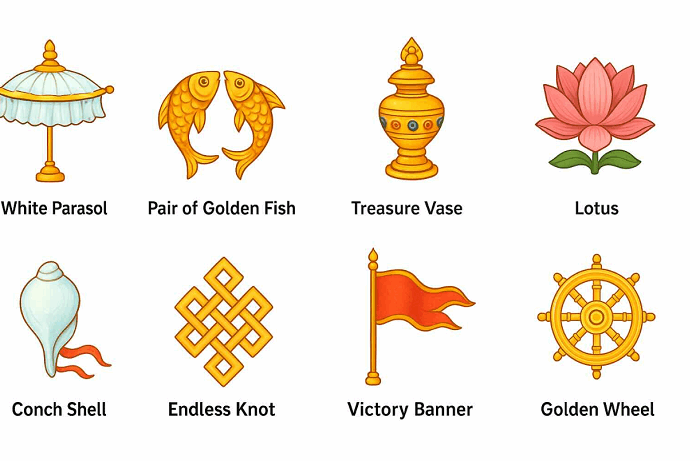
- The eight symbols are the White Parasol, Golden Fish, Treasure Vase, Lotus, Conch Shell, Endless Knot, Victory Banner, and Dharma Wheel.
- Each symbol expresses a particular Buddhist principle, from protection and freedom to wisdom, compassion, purity, and the Buddha’s teachings.
- The symbols frequently appear together in Tibetan Buddhist art, architecture, ritual objects, and cultural decorations.
- Understanding their meanings can give international travelers a deeper appreciation of Tibetan monasteries and religious artwork.
What Are The Eight Auspicious Symbols?
The Eight Auspicious Symbols are a traditional group of Buddhist emblems representing good fortune and spiritual qualities. In Tibetan Buddhism, they are particularly prominent and can be found throughout the cultural landscape of Tibet.
They are traditionally presented in the following order:
- White Parasol
- Golden Fish
- Treasure Vase
- Lotus
- Conch Shell
- Endless Knot
- Victory Banner
- Dharma Wheel
Although the symbols are often displayed together as a complete set, each has a distinct visual form and spiritual meaning.
For visitors traveling through Tibet, recognizing these eight symbols can make visits to monasteries and temples much more meaningful. A design that might initially appear to be simply decorative can actually represent protection, wisdom, compassion, purity, or the spread of Buddhist teachings.
The Eight Auspicious Symbols of Tibetan Buddhism
The White Parasol
The White Parasol is traditionally associated with royalty, dignity, protection, and spiritual authority. In Buddhist symbolism, it represents the ability to protect living beings from suffering, fear, and harmful influences.
The shape of the parasol itself contributes to its meaning. Its domed upper section is associated with wisdom, while the decorative silk valances hanging around its edges symbolize different forms of compassion and skillful means.
The parasol presented to the Buddha therefore represents much more than physical shelter. It expresses the Buddha’s ability to provide spiritual protection from delusion and fear.
In traditional societies, parasols were also associated with status and honor. Their connection with royalty makes the White Parasol an appropriate symbol for the dignity and spiritual power attributed to an enlightened teacher.
When depicted in Tibetan Buddhist art, the parasol may appear above sacred figures or among the other auspicious symbols. Its elegant shape also makes it one of the more visually distinctive elements in Tibetan religious decoration.
The White Parasol
The Golden Fish
The Golden Fish, usually represented as a pair of fish, symbolizes happiness, freedom, and spontaneity. Fish move freely through water without being restricted by the environment in which they live. This freedom of movement has traditionally been interpreted as a metaphor for liberation.
In a Buddhist context, the Golden Fish can therefore be understood as an expression of freedom from fear and limitation. Rather than being trapped by the difficulties of existence, beings who follow the Buddhist path can gradually develop greater spiritual freedom. The two fish are also commonly associated with harmony and auspiciousness. Their paired form gives the symbol a sense of balance and movement.
For international visitors, the Golden Fish may be one of the easiest symbols to identify once they know what to look for. It frequently appears in colorful wall paintings, carved decorations, textiles, and other forms of Tibetan Buddhist art.
Its message is particularly simple: spiritual freedom brings happiness.
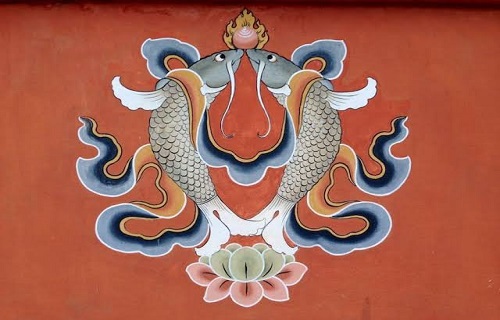
The Golden Fish
The Treasure Vase
The Treasure Vase is traditionally depicted as an ornate golden vessel, often decorated with lotus motifs. It represents an inexhaustible treasure, symbolizing abundance, prosperity, and the accumulation of spiritual qualities.
At the top of the vase may appear a wish-granting jewel or a group of three jewels. These three jewels represent the Buddha, Dharma, and Sangha, the central objects of Buddhist refuge. The Treasure Vase is therefore not simply a symbol of material wealth. Its deeper meaning concerns the abundance of positive qualities that can arise through spiritual practice.
The idea of an inexhaustible treasure is particularly important. Unlike ordinary wealth, which can be spent and eventually disappear, wisdom, compassion, virtue, and other wholesome qualities can continue to grow.
The ornate appearance of the Treasure Vase reflects this sense of richness. Its elaborate decoration makes it immediately recognizable in Tibetan Buddhist paintings and decorative art.
When seen alongside the other seven symbols, the Treasure Vase represents the idea that the Buddhist path can lead to an abundance of spiritual resources rather than merely worldly possessions.
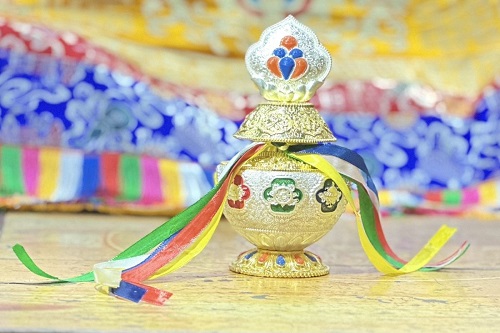
The Treasure Vase
The Lotus
Few Buddhist symbols are as widely recognized as the Lotus. The lotus grows from muddy or dark water, yet its flower rises above the surface and remains unstained. This natural characteristic has made it a powerful metaphor for purity, spiritual transformation, and liberation.
In Buddhist thought, human existence can be compared to the muddy water from which the lotus emerges. Life contains attachment, suffering, confusion, and other difficulties, yet these conditions do not prevent spiritual awakening.
The lotus therefore represents the possibility of developing purity and wisdom while living within the ordinary world.
The flower is also closely associated with Buddhist deities. Sacred figures are frequently shown sitting or standing upon lotus seats, emphasizing their pure and awakened nature.
For this reason, the lotus represents more than physical beauty. It symbolizes the blossoming of wholesome actions and the development of body, speech, and mind beyond the faults associated with cyclic existence.
Its symbolism also makes the lotus particularly meaningful when viewed in monasteries. A simple floral design may be communicating an important philosophical idea: purity is not necessarily achieved by escaping the world, but by transforming one’s relationship with it.
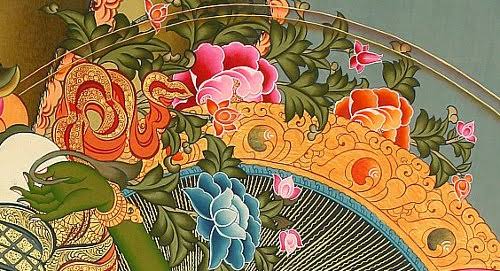
The Lotus
The Conch Shell
The Conch Shell represents the proclamation of the Buddha’s teachings and is particularly associated with the power of enlightened speech. In traditional Tibetan Buddhist imagery, the conch is commonly depicted vertically, often with a silk ribbon attached to its lower portion. A particularly auspicious form is the right-turning conch, whose spiral curves toward the right.
The conch has an important connection with sound. In the ancient world, a conch could be used to produce a powerful sound that traveled across considerable distances. This characteristic made it an appropriate symbol for the Buddha’s teachings spreading throughout the world.
In Buddhist symbolism, the sound of the conch can therefore be understood as the voice of Dharma reaching those who are ready to hear it. The conch may also appear as a vessel associated with aromatic substances or perfumes. As a ritual attribute, however, its most important symbolic function is connected with speech and the communication of wisdom.
For visitors exploring Tibetan monasteries, the conch is often recognizable by its distinctive spiral shape. Once you know its meaning, it becomes easier to identify it among the many symbolic elements found in Buddhist artwork.
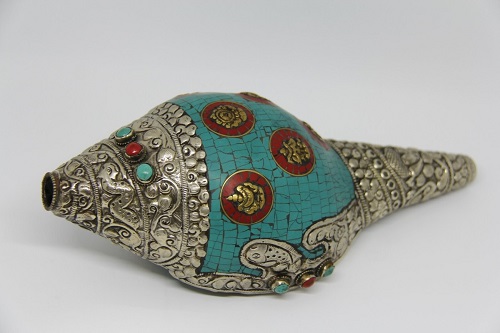
The Conch Shell
The Endless Knot
The Endless Knot, sometimes called the Lucky Diagram, is one of the most visually complex of the Eight Auspicious Symbols.
It consists of an interwoven pattern without a clear beginning or end. This continuous structure represents the interconnected nature of existence and the continuing relationship between different aspects of Buddhist philosophy. The Endless Knot is particularly associated with the Buddha’s wisdom and compassion. It can also represent the continuity of the twelve links of dependent origination, an important Buddhist teaching describing the interconnected processes underlying cyclic existence.
The absence of a visible beginning or ending is central to its symbolism. Every line appears to connect with another, illustrating the idea that phenomena do not exist entirely independently. This makes the Endless Knot especially interesting for travelers. Among the eight symbols, it is perhaps the one that most strongly encourages the viewer to stop and examine the design carefully. It can be found on monastery walls, doors, textiles, jewelry, handicrafts, paintings, and architectural details throughout Tibetan cultural areas.
Beyond its religious meaning, its symmetrical design has also become one of the most recognizable visual representations of Tibetan culture.
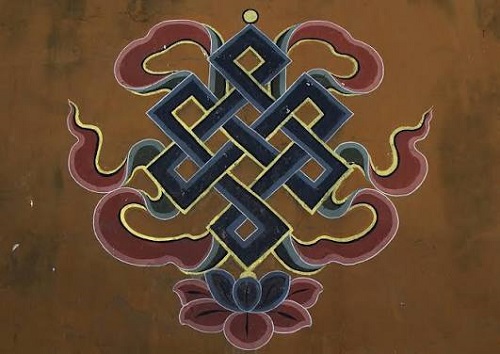
The Endless Knot
The Victory Banner
The Victory Banner represents triumph over obstacles, negative forces, and spiritual defilements.
In Tibetan Buddhist tradition, different forms of the Victory Banner are associated with different methods of overcoming the obstacles that prevent spiritual progress. The idea of victory here is not primarily about defeating another person. Instead, it concerns overcoming inner problems such as ignorance, attachment, fear, and other forms of mental confusion. This distinction is important when interpreting Buddhist symbolism. Victory is understood as a form of spiritual transformation.
The banner itself traditionally represents triumph and the successful establishment of wisdom and Dharma. Its elevated position in traditional imagery reinforces the idea of teachings overcoming obstacles and spreading throughout the world.
When combined with the other auspicious symbols, the Victory Banner expresses the possibility of overcoming difficulties through Buddhist practice.
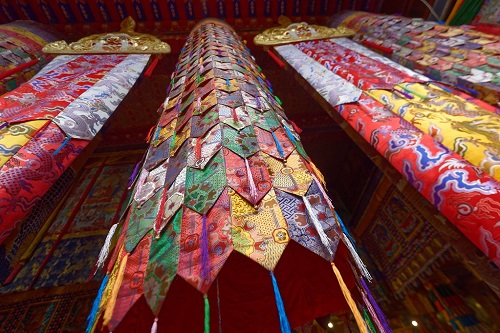
The Victory Banner
The Dharma Wheel
The Dharma Wheel, or Wheel of Dharma, is perhaps the most direct representation of the Buddha’s teachings. The wheel symbolizes the Dharma—the teachings and principles revealed by the Buddha. Its circular form also conveys movement, continuity, and the ongoing transmission of Buddhist wisdom.
The movement of the wheel can be understood as representing the transformative power of the Buddha’s teachings. Just as a wheel turns and moves forward, spiritual practice can lead a person from confusion toward greater understanding. The Dharma Wheel is particularly important because it connects the symbolic world of Buddhism directly with its teachings.
When the Buddha began teaching after attaining enlightenment, Buddhist tradition describes this as “turning the Wheel of Dharma.” The image of the wheel therefore represents the continuing journey of Buddhist wisdom from teacher to student and from one generation to the next.
In Tibetan Buddhist monasteries, the Dharma Wheel may be accompanied by two deer, a traditional representation associated with the Buddha’s first teaching.
For travelers, recognizing the Dharma Wheel can provide an immediate clue that a building, artwork, or monument is connected with Buddhist teachings.
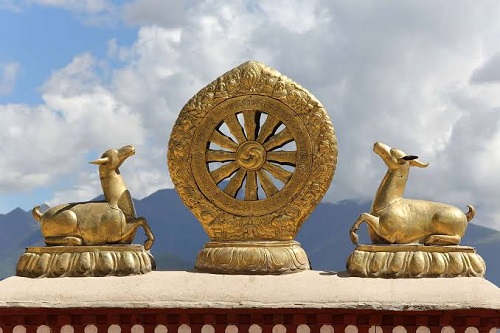
The Dharma Wheel
Why Are The Eight Symbols Often Shown Together?
Each of the Eight Auspicious Symbols has its own meaning, but their greatest significance comes from seeing them as a complete group.
Together, they create a visual summary of important Buddhist values.
The White Parasol represents protection and wisdom. The Golden Fish expresses freedom and happiness. The Treasure Vase represents abundance and spiritual wealth. The Lotus symbolizes purity and transformation. The Conch Shell represents the spread of Buddhist teachings. The Endless Knot expresses interconnection, wisdom, and compassion. The Victory Banner symbolizes triumph over obstacles. The Dharma Wheel represents the Buddha’s teachings and spiritual transformation.
Viewed together, these ideas create a symbolic journey from protection and freedom toward wisdom, purity, and ultimately spiritual awakening.
This is why the eight symbols are more than a collection of decorative motifs. They form a visual language.
The Eight Auspicious Symbols In Tibetan Culture
Travelers in Tibet encounter Buddhist symbolism in many different settings. The Eight Auspicious Symbols can appear on monastery walls, prayer flags, murals, thangkas, sculptures, furniture, carpets, clothing, handicrafts, and architectural features. They may also be displayed together as a decorative set.
Their presence reflects the close relationship between Tibetan Buddhist philosophy and everyday visual culture. Religious ideas are not confined to written texts; they are communicated through colors, shapes, gestures, architectural designs, and symbols that people encounter throughout daily life. This is particularly noticeable when visiting major monasteries in and around Lhasa, Shigatse, and other parts of Tibet.
Rather than viewing these symbols simply as souvenirs or decorations, travelers can regard them as a visual introduction to Buddhist ideas.
How To Recognize The Eight Symbols When Traveling In Tibet
Knowing their basic shapes makes identifying them surprisingly easy.
The White Parasol resembles an ornate umbrella. The Golden Fish appear as two fish facing or crossing around each other. The Treasure Vase looks like a decorated ceremonial vessel. The Lotus is represented by a blooming flower.
The Conch Shell has a distinctive spiral form, while the Endless Knot consists of interconnected lines forming a continuous pattern. The Victory Banner resembles a ceremonial flag, and the Dharma Wheel is a circular wheel, often with multiple spokes.
When visiting a Tibetan monastery, take time to look beyond the main statues and murals. These symbols can appear in unexpected places, including doorways, pillars, carpets, ceilings, and smaller decorative details.
Understanding what they mean can transform a sightseeing experience into a more meaningful cultural encounter.
Why The Eight Symbols Matter To International Visitors
For travelers who are unfamiliar with Tibetan Buddhism, the Eight Auspicious Symbols provide a useful starting point for understanding the region’s visual culture. They show how Buddhist philosophy can be communicated without relying on long written explanations. A single lotus can express purity and transformation, while an Endless Knot can represent complex ideas about interconnectedness.
This symbolic language is one reason Tibetan Buddhist art is so distinctive. Travelers should also remember that these symbols are religious rather than merely decorative. When photographing or purchasing Buddhist artwork, it is respectful to treat the symbols with the same cultural awareness given to religious objects in any other tradition.

Exploring Tibetan Buddhism With Tibet Yulong Travel
For international visitors, learning about the Eight Auspicious Symbols before a Tibet journey can add another layer of meaning to visits to monasteries, temples, and cultural sites.
Tibet Yulong Travel organizes Tibet journeys for international travelers and can help visitors experience the region beyond its famous landscapes. Routes can combine Lhasa’s major Buddhist landmarks with destinations such as Shigatse, Everest, and other culturally significant areas, allowing travelers to see how Tibetan Buddhism is expressed through architecture, art, pilgrimage, and everyday life.
Whether you are photographing a monastery mural, walking around a sacred site, or simply noticing a symbol carved into an old doorway, understanding the Eight Auspicious Symbols can help you see Tibetan culture from a deeper perspective.
Frequently Asked Questions About The Eight Auspicious Symbols
What Are The Eight Auspicious Symbols Of Tibetan Buddhism?
They are the White Parasol, Golden Fish, Treasure Vase, Lotus, Conch Shell, Endless Knot, Victory Banner, and Dharma Wheel. Together they form one of the best-known groups of Buddhist symbols.
What Are The Eight Auspicious Symbols Called In Tibetan?
They are commonly known as Tashi Takgyad, meaning the Eight Auspicious Symbols.
What Do The Eight Symbols Represent?
Together, they represent different aspects of Buddhist spiritual life, including protection, freedom, abundance, purity, enlightened speech, wisdom, compassion, overcoming obstacles, and the Buddha’s teachings.
Where Can I See The Eight Auspicious Symbols In Tibet?
They can be found throughout Tibetan Buddhist cultural sites, including monasteries, temples, murals, sculptures, prayer flags, textiles, handicrafts, and architectural decorations.
Why Is The Lotus Important In Buddhism?
The lotus represents purity and spiritual transformation because it grows from muddy water while remaining unstained. It is therefore a powerful metaphor for developing wisdom and purity despite the difficulties of ordinary existence.
What Does The Dharma Wheel Mean?
The Dharma Wheel represents the Buddha’s teachings and the continuing transmission of Buddhist wisdom. Its movement symbolizes spiritual transformation and the spreading of Dharma.
Final Thoughts
The Eight Auspicious Symbols provide a fascinating introduction to the visual language of Tibetan Buddhism. From the protective White Parasol to the liberating Golden Fish, the pure Lotus, interconnected Endless Knot, triumphant Victory Banner, and transformative Dharma Wheel, each symbol carries a distinct message.
For international travelers, learning these symbols before visiting Tibet can make temples, monasteries, murals, and traditional artwork much easier to understand. What might initially look like an elaborate pattern may actually express centuries-old ideas about wisdom, compassion, purity, freedom, and enlightenment.
More importantly, the eight symbols demonstrate how Tibetan Buddhism turns profound philosophical concepts into a visual language that can be recognized and appreciated even by visitors encountering it for the first time.