
Nestled in the heart of the Khumbu region, Lukla Airport stands as one of the most famous and thrilling aviation hubs on the planet. Serving as the primary starting point for trekkers heading toward Mount Everest Base Camp, this small airstrip offers an experience unlike any other commercial flight. The journey here is not just a means of transportation; it is an initiation into the rugged beauty of the Himalayas. Built to connect remote mountain communities with the rest of Nepal, the airport has evolved into a legendary waypoint for adventurers worldwide. Every year, thousands of hikers, climbers, and cultural enthusiasts pass through its modest terminal, eager to begin their ascent into the high mountains. Understanding what makes this destination so unique is essential before booking your tickets and lacing up your hiking boots.
Key Takeaways:
- Lukla Airport is the main gateway for Everest Base Camp treks.
- The runway is exceptionally short and perched on a steep incline.
- Flights are highly dependent on unpredictable mountain weather conditions.
- Only small STOL aircraft are authorized to land at this airstrip.
- Proper acclimatization should begin immediately upon landing.
The History and Significance of Lukla Airport
Before the construction of the airstrip, reaching the Solu-Khumbu region required days of grueling overland trekking from the nearest road head. Sir Edmund Hillary, who alongside Tenzing Norgay first summited Mount Everest, recognized the need for better infrastructure to support local communities and future expeditions. He spearheaded the project in the 1960s, initially purchasing the flat land from local Sherpa farmers. Legend has it that Hillary paid for the land using local currency and a generous supply of spirits to help negotiate the deal. The original runway was flattened by local laborers who reportedly danced on the tarmac to compact the earth after consuming traditional beverages.
Over the decades, Lukla Airport transformed from a rudimentary dirt strip into a paved runway capable of handling specialized aircraft. It was officially renamed Tenzing-Hillary Airport in 2008 to honor the two mountaineering pioneers. Today, it serves a dual purpose: it is a vital lifeline for the local Sherpa population, delivering food, medicine, and building materials, while simultaneously acting as the bustling launchpad for the global trekking industry. Without this crucial piece of infrastructure, the modern Everest tourism economy would look vastly different, and access to the upper Khumbu valleys would remain restricted to only the most hardened expedition teams.
Why Lukla Airport is Considered One of the World’s Most Thrilling Airports
Aviation enthusiasts and nervous flyers alike know the reputation of Lukla Airport. The statistics behind the runway explain the thrill. The paved strip measures only about 527 meters (1,729 feet) in length and roughly 30 meters in width. To put that into perspective, standard international runways often exceed 3,000 meters. Furthermore, the runway sits at an elevation of approximately 2,845 meters (9,334 feet) above sea level, where the thin air significantly reduces engine performance and aerodynamic lift.
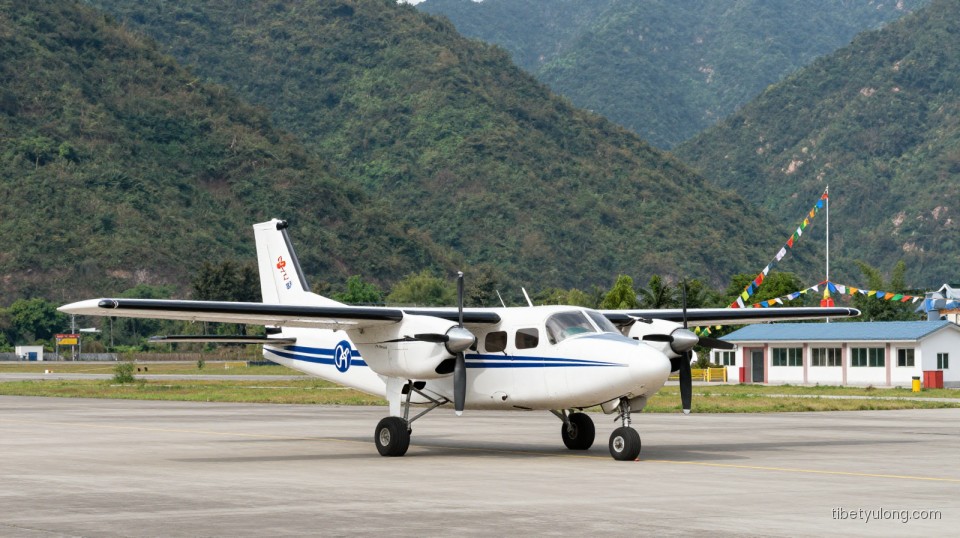
The geography surrounding the airstrip leaves absolutely no margin for error. At the upper end of the runway lies a steep mountain face, while the lower end drops off abruptly into a deep valley gorge. To assist aircraft in slowing down, the runway is built on a 12-degree gradient, sloping upward. Pilots must execute a precise approach, navigating through narrow mountain corridors, often without the aid of advanced radar or instrument landing systems found at major airports. Because of these extreme constraints, only Short Takeoff and Landing (STOL) aircraft, such as the de Havilland Canada DHC-6 Twin Otter and the Dornier 228, are permitted to operate here. Helicopters also frequently use the adjacent helipad for charter flights and rescue operations.
Navigating Weather and Flight Schedules at Lukla Airport
If there is one golden rule when planning a trip through Lukla Airport, it is to build buffer days into your itinerary. Mountain weather is notoriously volatile. While Kathmandu might be experiencing clear blue skies, the Khumbu region could be blanketed in dense clouds, heavy rain, or snow. Flights are predominantly scheduled during the early morning hours. As the sun rises and heats the valleys, thermal currents generate clouds and wind shear, making afternoon landings incredibly dangerous and frequently resulting in cancellations.
During peak trekking seasons—typically spring (March to May) and autumn (September to November)—the demand for seats far exceeds supply. When bad weather delays flights for consecutive days, a massive backlog of stranded passengers accumulates in both Kathmandu and Lukla. Travelers may find themselves waiting for days before securing a seat. Patience is not just a virtue here; it is a strict requirement. Many seasoned trekkers recommend booking the earliest possible flight out of Kathmandu to maximize the chances of beating the afternoon cloud cover. Alternatively, helicopter charters can sometimes fly under lower cloud ceilings than fixed-wing aircraft, offering a costly but reliable backup option when regular flights are grounded.
Safety Measures and Pilot Expertise at Lukla Airport
Despite its daunting reputation, flying into Lukla Airport is generally safe when operated by experienced crews. The Civil Aviation Authority of Nepal enforces stringent regulations for airlines operating on this route. Pilots cannot simply request to fly to Lukla; they must accumulate a specific number of flight hours in Nepal’s mountainous terrain and complete rigorous specialized training programs focused on visual flight rules (VFR) and STOL operations.
Airlines utilize veteran captains who have flown the route hundreds, if not thousands, of times. These pilots possess an intimate understanding of the local microclimates, wind patterns, and topographical landmarks. They rely heavily on visual cues rather than instruments. If a pilot approaches the valley and determines that visibility has dropped below acceptable minimums, they will abort the landing and return to the departure airport without hesitation. This strict adherence to safety protocols ensures that while the flight is undeniably adventurous, it is managed by professionals who prioritize passenger lives over schedule adherence. Modern STOL aircraft are also maintained to high standards, designed specifically to handle the demanding physics of short, high-altitude runways.
Starting Your Everest Trek from Lukla Airport
Stepping off the aircraft onto the tarmac of Lukla Airport is a sensory awakening. The crisp, thin mountain air hits your lungs, and the panoramic views of terraced hillsides and distant snow-capped peaks signal that your real journey has begun. The town of Lukla itself is a vibrant, chaotic hub filled with trekking lodges, gear shops, bakeries, and porters organizing loads. It is advisable not to rush your departure from the town. Spending a few hours resting, hydrating, and allowing your body to adjust to the nearly 3,000-meter altitude is a smart strategy against acute mountain sickness.
The classic trail to Everest Base Camp begins just beyond the edge of the runway. Trekkers typically descend slightly before beginning the long series of ascents toward Namche Bazaar, Phakding, and eventually the higher camps. For those seeking professional guidance, arranging logistics through experienced operators is highly recommended. Agencies familiar with the region, such as Tibet Yulong Travel, offer comprehensive trekking packages that handle everything from domestic flight bookings and permit acquisitions to guide services and teahouse reservations along the trail. Utilizing a knowledgeable travel service ensures that the logistical stress of navigating the Khumbu region is minimized, allowing you to focus entirely on the breathtaking landscapes and rich Sherpa culture.
Practical Tips for Travelers Using Lukla Airport
Packing efficiently is critical when flying into Lukla Airport. Airlines enforce strict baggage weight limits, usually capping total luggage (checked and carry-on combined) at 10 to 15 kilograms per passenger. Excess baggage is either charged at premium rates or left behind. Pack versatile, layered clothing suitable for rapidly changing mountain temperatures. Keep all essential medications, valuables, and a day’s worth of trekking gear in your carry-on bag, just in case your checked luggage is delayed due to weight restrictions on smaller aircraft.
When boarding your flight, seating matters more than usual. For the best aerial views of the Himalayan range during the flight from Kathmandu, try to secure a window seat on the left side of the aircraft. Conversely, on the return journey, the right side offers the most spectacular vistas. Finally, maintain a flexible mindset. Treat the flight not merely as transit, but as an integral part of your Himalayan adventure. The roar of the twin engines, the dramatic banking through river gorges, and the sudden appearance of the steep runway rushing up to meet the wheels are memories that define the entire expedition long before you ever take your first step on the trail to Everest.