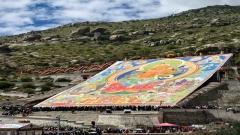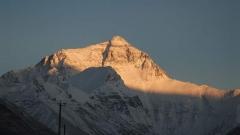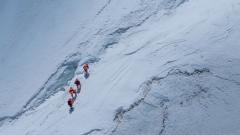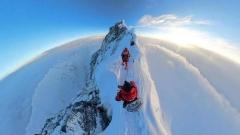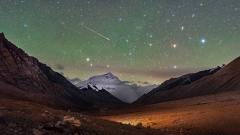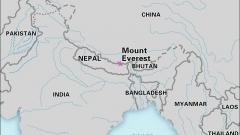

Mount Everest is more than the highest mountain above sea level. It is the best-known summit in a Himalayan landscape shaped by immense geological forces, ancient cultures, sacred traditions, and generations of exploration. Rising to 8,848.86 meters (29,031.7 feet) above sea level, Everest stands on the border between Nepal and the Tibet Autonomous Region of China and forms part of the Mahalangur Himalaya.
For international travelers, however, Everest is only one part of a much larger story. The Himalayas stretch across several countries and contain hundreds of remarkable peaks, from Lhotse and Makalu to Kanchenjunga. Beyond the mountains themselves are Tibetan Buddhist monasteries, Sherpa communities, high-altitude valleys, glaciers, lakes, and some of Asia’s most important river systems.
Key Points At A Glance
- Mount Everest is the highest mountain above sea level, reaching 8,848.86 meters (29,031.7 feet).
- Everest is one mountain within the much larger Himalayan mountain system, not another name for the Himalayas.
- The Himalayas extend for roughly 2,400 kilometers across Asia, passing through several countries and containing many of the world’s highest peaks.
- Everest belongs to the Mahalangur Himalaya, close to Lhotse, Nuptse, and other major Himalayan summits.
- Everest and K2 are the world’s two highest mountains, but K2 lies in the Karakoram rather than the Himalayas.
- Lhotse is Everest’s closest giant neighbor, connected to it by the South Col.
- Visitors do not need to climb Everest to experience it. Everest Base Camp, Himalayan viewpoints, trekking routes, and overland journeys through Tibet offer different ways to encounter the world’s highest peak.
Mount Everest And The Himalayas: What Is The Difference?
One of the most common questions among first-time visitors is whether Mount Everest and the Himalayas are the same thing. They are not.
The Himalayas are a vast mountain system, while Mount Everest is a single mountain within that system. The range extends for approximately 2,400 kilometers across parts of China, Nepal, India, Bhutan, and Pakistan and contains a remarkable concentration of high peaks.
Everest rises from the Mahalangur Himalaya, a sub-range that also includes Lhotse, Nuptse, and Makalu. In other words, seeing Everest means experiencing one extraordinary summit within a much larger geographical and cultural world.
The Himalayas themselves were created by the continuing collision of the Indian and Eurasian tectonic plates. This geological process began tens of millions of years ago and continues today, helping explain why the region remains one of the most active mountain-building areas on Earth.
The importance of the Himalayas also extends far beyond their peaks. Glaciers, snowfields, forests, grasslands, and rivers connect the mountains with enormous populations across Asia. Major river systems, including the Ganges, Brahmaputra, and Indus, are linked to water originating in or around the Himalayan region.
For travelers, this means an Everest journey is not simply a visit to the world’s highest mountain. It can also be a journey through one of the planet’s most extraordinary combinations of geography, culture, wildlife, and spirituality.
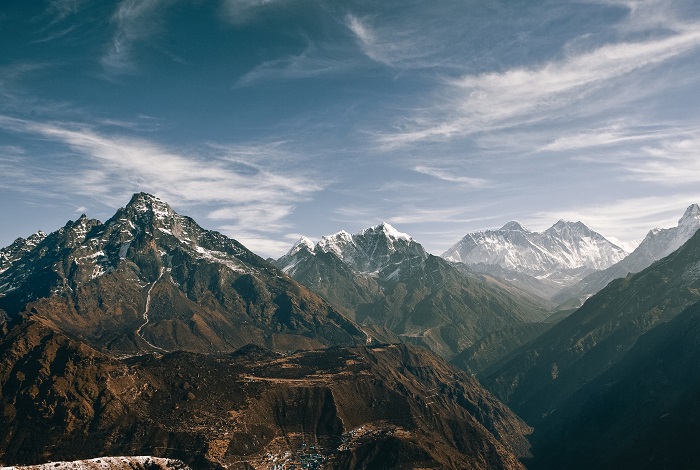
Mount Everest and The Himalayas
Why Is Mount Everest So Famous?
Height is the obvious answer, but it does not fully explain Everest’s global appeal.
Everest represents the highest point above sea level on Earth. That simple distinction has made it a symbol of exploration and human ambition for generations. Yet its fame has also been shaped by mountaineering history, photography, scientific research, popular culture, and the communities living around the mountain.
The mountain is particularly striking because of its surroundings. Everest does not rise alone. It belongs to a dramatic landscape of glaciers, ridges, enormous neighboring peaks, and high valleys. From suitable viewpoints, visitors can see an entire Himalayan skyline rather than an isolated summit.
The names used for Everest also reveal its cultural importance. In Nepal, it is widely known as Sagarmatha, while in Tibet it is called Chomolungma. These names reflect traditions and cultural perspectives that existed long before Everest became an international mountaineering destination.
For travelers, therefore, Everest is best understood as more than a record-breaking mountain. It is a geographical landmark, a cultural symbol, and a destination whose meaning changes depending on how you approach it.
Everest And K2: The Two Highest Giants
Everest and K2 are frequently compared because they occupy the first and second positions among the world’s highest mountains.
Everest reaches 8,848.86 meters, while K2 rises to 8,611 meters. The difference is approximately 238 meters, but height alone does not determine climbing difficulty.
K2 is located in the Karakoram on the Pakistan-China border rather than in the Himalayas. Its steep faces, technical climbing sections, unstable weather, and demanding routes have earned it the nickname “Savage Mountain.”
Everest, by contrast, has developed a much more extensive mountaineering infrastructure. Established climbing routes, fixed ropes, high-altitude camps, experienced guides, and decades of expedition knowledge have made Everest more accessible to qualified climbers, although it remains an extremely dangerous high-altitude environment.
This distinction is important for travelers. The highest mountain is not automatically the most technically difficult mountain. Everest’s reputation comes partly from its altitude and exposure, while K2 is particularly notorious for steep, technical terrain and unpredictable conditions.
For ordinary visitors, neither mountain needs to be climbed to be appreciated. Everest Base Camp and Himalayan viewpoints provide spectacular ways to experience Everest without attempting a summit expedition.
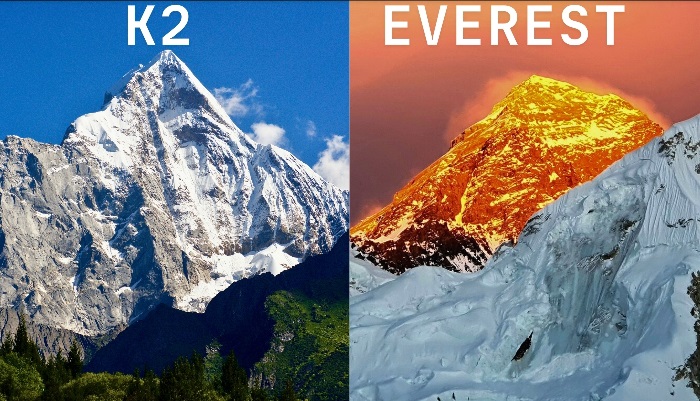
Everest And K2
Everest And Lhotse: Neighbors On The Roof Of The World
Few mountains are as closely associated with Everest as Lhotse, the world’s fourth-highest mountain at approximately 8,516 meters.
Lhotse and Everest are part of the same Himalayan massif and are connected by the South Col, a high mountain pass used by climbers approaching Everest from the Nepal side. The two summits are so close geographically that they often appear as part of a single enormous Himalayan landscape.
Their climbing experiences, however, differ.
Everest is famous for the Khumbu Icefall, extreme altitude, long summit routes, and the final ascent through the upper mountain. Lhotse is particularly known for its steep terrain and the formidable Lhotse Face, which presents demanding sections of ice and rock.
This relationship illustrates an important feature of the Himalayas: the world’s highest mountains often exist in tightly packed clusters. A traveler looking across the Himalayan horizon may see several peaks exceeding 8,000 meters within the same panorama.
That is one reason the Everest region is so visually extraordinary. The destination is not simply about finding one summit. It is about entering an entire landscape of giants.
Everest And Kanchenjunga: Height, Wilderness And Sacred Meaning
At 8,586 meters, Kanchenjunga is the world’s third-highest mountain. It stands along the Nepal-India border and is particularly important in the cultural traditions of Sikkim and eastern Nepal.
Compared with Everest, Kanchenjunga receives far fewer climbers and has a reputation for remoteness, technical difficulty, challenging weather, and serious avalanche hazards.
The cultural contrast is equally significant. Everest has become an international symbol of mountaineering, while Kanchenjunga retains a particularly strong sacred identity. Mountaineering traditions around the mountain have historically shown respect for local beliefs, with summit climbers traditionally stopping slightly short of the true summit.
The comparison demonstrates that Himalayan mountains cannot be judged only by elevation. A peak can be important because of its height, climbing history, spiritual significance, ecological value, or relationship with surrounding communities.
Everest And Annapurna: Highest Does Not Mean Most Dangerous
Annapurna I, at 8,091 meters, is significantly lower than Everest and ranks tenth among the world’s highest mountains. Yet Annapurna has long been regarded as one of the most demanding and dangerous 8,000-meter peaks.
Its steep terrain, avalanche exposure, remote sections, and rapidly changing weather create a different mountaineering challenge from Everest.
Everest’s extensive infrastructure means that climbers can follow established routes supported by generations of accumulated knowledge. Annapurna is less commercialized and has a reputation for more unpredictable climbing conditions.
For tourists, this comparison is useful because it shows why Himalayan travel cannot be reduced to a ranking of mountain heights. The experience of visiting a mountain depends on geography, accessibility, climate, culture, and the purpose of the journey.
The Story Of Edmund Hillary And Tenzing Norgay
The modern history of Everest changed forever on May 29, 1953, when New Zealand mountaineer Edmund Hillary and Sherpa climber Tenzing Norgay reached the summit.
Their achievement followed decades of exploration and unsuccessful attempts by earlier expeditions. Reaching the summit was not simply a matter of physical strength. It required route planning, acclimatization, logistics, teamwork, specialized equipment, and the accumulated knowledge of many expedition members.
Hillary later became known not only for Everest but also for his long-term work in the Himalayan region. Through the Himalayan Trust, he supported schools, hospitals, and other projects serving communities in Nepal.
The story of Everest should therefore not be told as a story of one individual “conquering” a mountain. The successful ascent depended on collaboration between climbers, Sherpas, expedition workers, scientists, and local communities.
That broader perspective is increasingly important when discussing responsible tourism in the Himalayas.

Edmund Hillary
Sherpas And The Human Story Of Everest
The Sherpa people are an essential part of Everest’s modern history.
Sherpa communities have deep roots in the high Himalayan valleys of Nepal, particularly the Khumbu region. Their knowledge of mountain terrain, weather, routes, and high-altitude logistics has made Sherpa guides and workers central to expeditions on Everest.
Their contributions extend far beyond carrying equipment. Sherpa mountaineers have established camps, fixed ropes, transported supplies, supported rescues, guided climbers, and undertaken some of the most dangerous work on the mountain.
Tenzing Norgay’s 1953 summit achievement helped introduce the world to the extraordinary role of Sherpa climbers. Today, Sherpa mountaineers continue to play a critical role in Himalayan expeditions.
For visitors traveling through the Everest region, understanding this human dimension makes the experience more meaningful. The Himalayas are not an empty wilderness waiting to be discovered. They are home to communities with long histories, traditions, languages, religious practices, and relationships with the landscape.
Everest And Mount Kailash: Two Very Different Himalayan Experiences
Mount Everest and Mount Kailash demonstrate another side of Himalayan diversity.
Everest is associated with exploration and mountaineering, while Kailash is primarily associated with pilgrimage and spiritual devotion. At approximately 6,638 meters, Kailash is far lower than Everest, yet its religious importance is immense.
Mount Kailash is revered in Hinduism, Buddhism, Jainism, and the Bon tradition. Rather than climbing the summit, pilgrims traditionally undertake the Kailash Kora, a circumambulation around the mountain.
This distinction is particularly relevant for international tourists visiting Tibet. The Himalayan landscape can be experienced through adventure, photography, cultural exploration, pilgrimage, trekking, or simply contemplation.
Everest may represent the physical limits of altitude, while Kailash demonstrates that a mountain’s significance cannot be measured in meters alone.
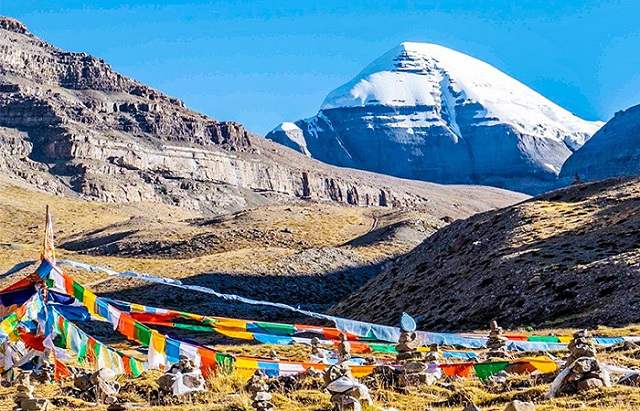
Mount Kailash
Everest Compared With The World’s Other Great Heights
Everest also becomes more fascinating when compared with mountains and structures outside the Himalayas.
Mount Kilimanjaro, Africa’s highest mountain at 5,895 meters, offers a very different trekking experience. It can be climbed without the technical mountaineering skills required on Everest, although altitude remains a serious consideration.
Mauna Kea in Hawaii illustrates another definition of “tallest.” Measured from its base on the ocean floor to its summit, it rises more than 10,000 meters, exceeding Everest in total vertical height. Above sea level, however, it is far lower than Everest.
Mauna Loa, also in Hawaii, demonstrates how a mountain can dominate through sheer mass and volume rather than elevation.
Beyond Earth, Olympus Mons on Mars reaches roughly 22 kilometers above the surrounding Martian surface, dramatically exceeding Everest in height. Its enormous scale reflects the different geological history of Mars.
Even the Burj Khalifa, the world’s tallest building, provides an interesting comparison. At 828 meters, nearly eleven Burj Khalifas would be needed to equal Everest’s elevation above sea level.
These comparisons reveal why the phrase “highest mountain” needs context. Everest is the highest mountain above sea level on Earth, and that definition is the one that gives it its famous world record.
Everest And The Mariana Trench: Earth’s Vertical Extremes
The contrast between Everest and the Mariana Trench offers another extraordinary perspective.
Everest rises nearly 8.85 kilometers above sea level, while Challenger Deep in the Mariana Trench reaches roughly 10.9 kilometers below sea level. Together, they illustrate the enormous vertical range of Earth’s surface.
Yet the challenges are completely different. Everest exposes humans to extreme cold, low oxygen, high winds, avalanches, and altitude-related illness. The Mariana Trench presents crushing pressure, darkness, extreme depth, and immense technical challenges for exploration.
Both environments demonstrate how much of our planet remains extreme even in an age of advanced technology.
What Can International Tourists Experience Around Everest?
Not everyone who visits Everest intends to climb it, and most travelers should not attempt to treat a sightseeing trip as a mountaineering expedition.
International visitors can experience the mountain through trekking, scenic overland travel, photography, cultural tours, or visits to Everest Base Camp.
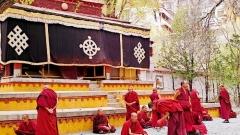
On the Tibetan side, the journey to Everest Base Camp near Rongbuk provides an especially distinctive perspective. Rather than following a long trekking approach from Nepal, visitors can travel overland through the Tibetan Plateau, passing through high mountain passes, traditional communities, monasteries, and vast open landscapes.
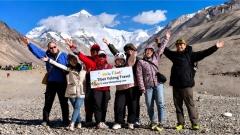
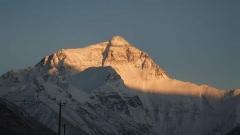
The Tibetan side also offers spectacular views of Everest’s north face when weather conditions are favorable. For photographers, the combination of immense scale, clear high-altitude skies, monasteries, prayer flags, and surrounding peaks creates a uniquely Tibetan interpretation of the Everest experience.
However, altitude should never be underestimated. Lhasa itself sits at approximately 3,650 meters, and the journey toward Everest climbs considerably higher. A carefully planned itinerary, gradual acclimatization, hydration, appropriate clothing, and professional local support are important for international visitors.
When Is The Best Time To See Everest?
The ideal season depends on what you want to do.
For clear mountain views, spring and autumn are generally among the most attractive periods. Spring brings increasing warmth and mountaineering activity, while autumn often offers crisp air and excellent visibility after the summer monsoon.
For photography, visibility is often more important than temperature. A cold day with clear skies can provide a much better Everest view than a warmer day hidden by clouds.
Winter offers a different experience, with fewer visitors and exceptionally crisp conditions on some days, but temperatures can be severe and travel conditions more demanding.
Ultimately, the best time for an international tourist depends on whether the priority is trekking, photography, cultural sightseeing, Everest Base Camp, or combining Everest with other destinations in Tibet.
Why The Himalayas Matter Beyond Tourism
The Himalayas are too important to be viewed simply as an adventure destination.
The mountains influence regional climate, water resources, biodiversity, agriculture, and local livelihoods. Glaciers and snowfields contribute to major river systems, while different elevations support ecosystems ranging from subtropical forests to high-altitude deserts.
Tourism brings important economic opportunities to mountain communities, but it also creates pressure. Waste management, resource consumption, trail erosion, changing landscapes, and the environmental footprint of large expeditions all require attention.
Responsible visitors can contribute by respecting local customs, minimizing waste, following designated routes, supporting local businesses, avoiding unnecessary single-use plastics, and listening to local guides.
The future of Everest tourism depends not only on how many people can reach the mountain, but on whether future generations can experience the same extraordinary landscape.
Experience Mount Everest From The Tibetan Side With Tibet Yulong
For international travelers who want to experience Everest without undertaking a technical climbing expedition, a journey through Tibet can combine the mountain with the cultural and geographical highlights of the Tibetan Plateau. Tibet Yulong Travel specializes in Tibet journeys for international visitors, including Lhasa-to-Everest Base Camp itineraries, private trips, small-group tours, and customized routes. Its Everest journeys can combine Lhasa, Yamdrok Lake, Gyantse, Shigatse, Rongbuk, and the Everest Base Camp area, allowing travelers to experience both Tibetan culture and the Himalayan landscape in one journey.
A well-planned Everest journey is ultimately about more than reaching a viewpoint. It is about crossing a landscape where immense mountains, Tibetan culture, ancient monasteries, high-altitude communities, and extraordinary natural environments exist side by side. For travelers who want to see Everest from Tibet, working with a local operator can also simplify transportation, permits, accommodation, guides, and the practical challenges of traveling at high altitude.
Everest Is Only The Beginning
Mount Everest may be the highest mountain above sea level, but its greatest significance comes from the world surrounding it.
The Himalayas contain a remarkable collection of peaks, cultures, ecosystems, glaciers, rivers, and communities. Everest shares this landscape with Lhotse, Makalu, Nuptse, and countless other mountains, while its story is connected to Sherpa communities, Tibetan traditions, pioneering climbers, modern travelers, and the continuing challenge of protecting fragile high-altitude environments.
For mountaineers, Everest remains an extraordinary test of preparation and endurance. For trekkers, photographers, and international tourists, it can be the centerpiece of a much broader Himalayan journey.
Standing before Everest, whether from the Tibetan side or elsewhere in the Himalayas, offers a useful reminder: the world’s greatest peaks are not merely records to be broken. They are landscapes to be understood, cultures to be respected, and natural environments to be protected.